Brief Followup to World As Neural Network

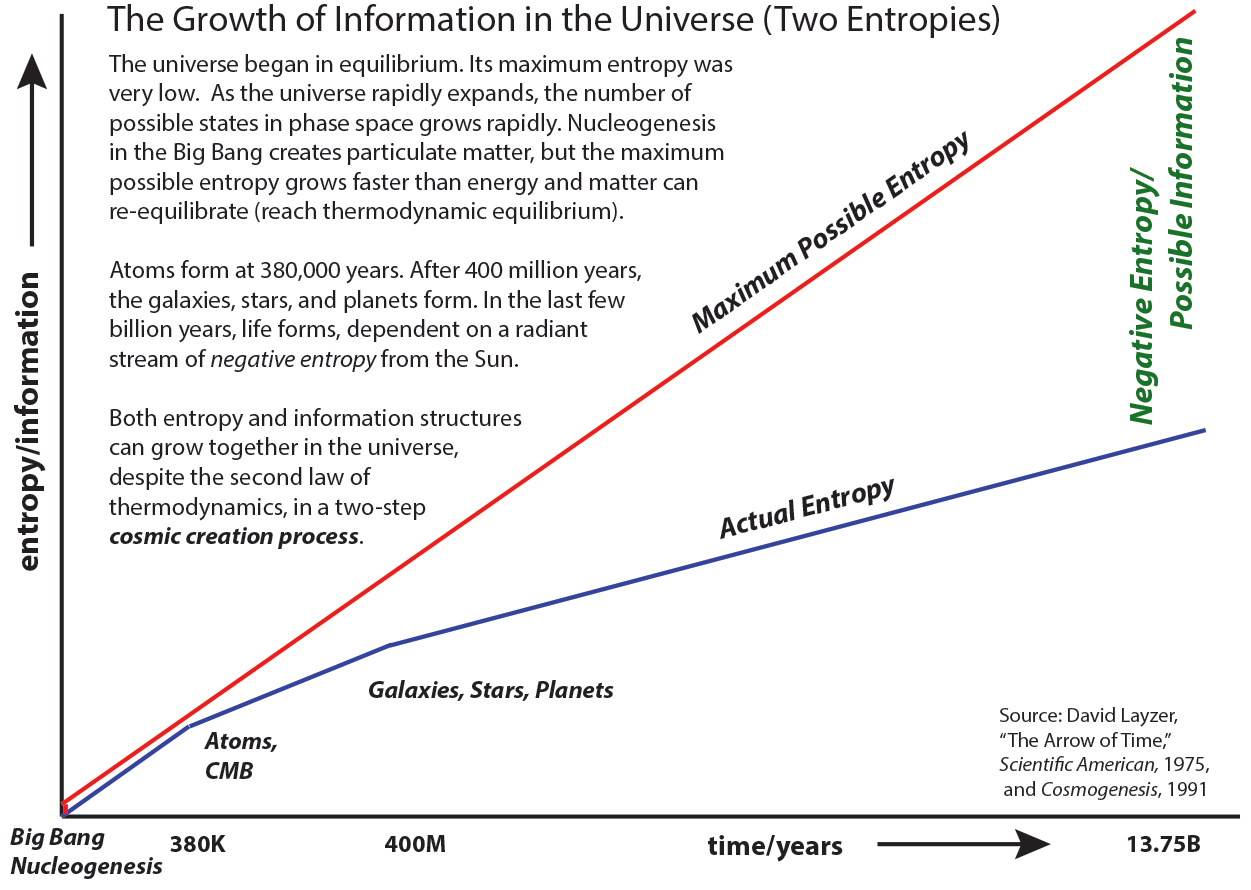
Some of the claims for the theory dealt with in my last post were fairly astonishing and we should rightfully be skeptical of them. However, I would like to point out that the idea that entropy could be connected to the evolution of universe and the accumulation of information and complexity is not new with that theory. David Layzer, a Harvard cosmologist, in the 1960’s and 1970’s made the argument that there could be an increasing gap between the maximum possible entropy and the actual entropy of the universe. This gap could provide an explanation for the growth of order or information at the same time entropy is increasing.

Posted in Entropy, Information | 11 Comments

World As Neural Network?

I’m interested in getting people reactions to this paper: The world as a neural network.

Here’s a fragment of the abstract that omits the technical parts:

We discuss a possibility that the entire universe on its most fundamental level is a neural network…This shows that the learning dynamics of a neural network can indeed exhibit approximate behaviors described by both quantum mechanics and general relativity. We also discuss a possibility that the two descriptions are holographic duals of each other.

Here’s an article and interview with the author.

I don’t understand the math and I’m skeptical of another Theory of Everything, but there are few items that struck a cord with me.

For one thing, it tries to tie learning to entropy and to view the evolution of the universe as terms of learning. This includes, of course, the physical aspects of the universe, but also biological evolution, as a form of learning. Consciousness and its association with learning emerges directly from the overall processes.

Indeed, if the entire universe is a neural network, then something like natural selection might be happening on all scales from cosmological (> 10+15 m) and biological (10+2 − 10−6 m) all the way to subatomic (< 10−15 m) scales. The main idea is that some local structures (or architectures) of neural networks are more stable against external perturbations (i.e. interactions with the rest of the network) than other local structures. As a result the more stable structures are more likely to survive and the less stable structures are more likely to be exterminated. There is no reason to expect that this process might stop at a fixed time or might be confined to a fixed scale and so the evolution must continue indefinitely and on all scales. We have already seen that on the smallest scales the learning evolution is likely to produce structures of a very low complexity (i.e. second law of learning) such as one dimensional chains of neurons, but this might just be the beginning. As the learning progresses these chains can chop off loops, form junctions and according to natural selection the more stable structures would survive. If correct, then what we now call atoms and particles might actually be the outcomes of a long evolution starting from some very low complexity structures and what we now call macroscopic observers and biological cells might be the outcome of an even longer evolution. Of course, at present the claim that natural selection may be relevant on all scales is very speculative, but it seems that neural networks do offer an interesting new perspective on the problem of observers.

Posted in Consciousness, Quantum Mechanics | 15 Comments

Origins of Qualia and Self

I have never been a fan of the so-called “hard problem” of consciousness. In part, this is probably because I never have considered myself a philosopher. While, like most people, I have some “philosophical” ideas, philosophy itself as a formal, academic discipline always has seemed like an elaborate form of intellectual activity serving no practical purpose. Count me a pragmatist if we must pick a philosophical word, I am more interested in science and results than elaborately spun arguments which seem to turn back on themselves in the end. I have written previously about the “hard problem” which I consider something of a trap for scientists (armchair or otherwise) since in my opinion it is inherently unanswerable. We cannot answer why red is red or green is green any more than we can answer why there is something rather than nothing. Many neuroscientists seem to suspect the problem is unsolvable and avoid it altogether. This does not seem to stop some physicists and other scientists from trying to solve it with a “just physics and chemistry” answer while omitting almost all of the in-betweens, leaving consciousness almost as much of a mystery as the philosophers.

While I think the exact and rigid form of the “hard problem” is unsolvable (and probably meaningless), that does not mean that I think a weaker form of the problem might not be meaningful. Give me some explanation how qualia, which seem very immaterial, arise from matter. Certainly the “just physics and chemistry” answer is inadequate, even if it is ultimately correct, because we can explain everything the same way. Neuroscientists, for the most part, barely improve on that answer when they answer it is “just neurons firing”. “Just neurons firing”, like “just physics and chemistry”, will likely be ultimately correct but it does not tell me the important thing: how do neurons firing result in something that looks like our experience? It does not do enough to fill the gap between electrochemical activity in a piece of meat to something that looks to us on the inside like what we call mind.

For the most part, neuroscientists have been disappointing in their answers.

Until now. I have now read an interesting explanation that at least provides some plausible “in-betweens” even if it does not have all the answers. What is more, it was written in book published nearly twenty years ago.

Continue reading

Posted in Consciousness, Electromagnetism, Human Evolution, Intelligence | 43 Comments