Although, as the Stanford Encyclopedia of Philosophy notes, subjectivity should probably be considered an aspect of consciousness rather than equivalent to it. Subjectivity is, however, frequently mentioned as a problem needing explanation. It is also closely aligned with the notion of consciousness as private.
But is it a problem at all?
In fact, I think subjectivity is a good representation of reality.
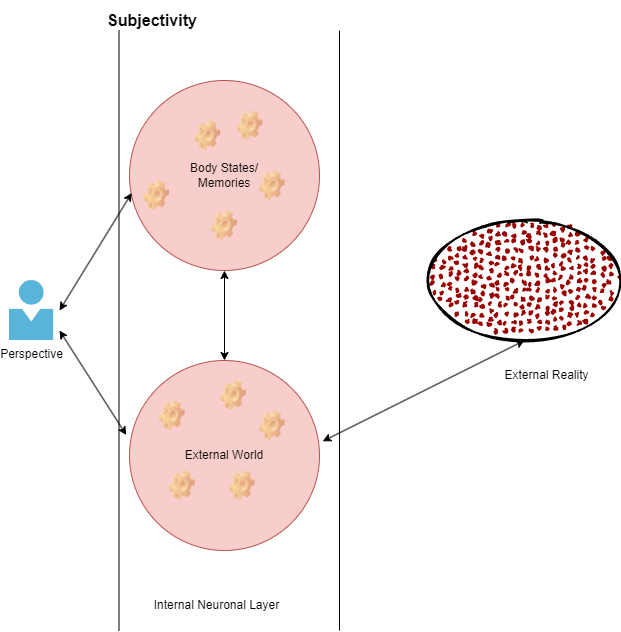
In fact, I think all reality we know is subjective. It is just that some of that reality mimics aspects of the reality outside of our own subjective one. From the perspective of our consciousness experience, we only perceive second-hand neuronal representations of external and internal reality. Those representations are internal and subjective.
This might be a little New Agey but I’ll try to keep it a little more sciency if I can.
I blogged about a month ago about a David Tong video about the simulation hypothesis. That arose from a question in Scott Aaronson’s blog about the fact that the Standard Model could not be simulated on a computer. That fact would suggest that reality is analog not digital. It turns out there is a solution to the problem but the solution involves an extra dimension. Scott has since followed up with a new post on the simulation hypothesis where he mentions the solution.
So what is this extra dimension? Is it the same as the extra dimension in the Kaluza-Klein theory that tries to unify electromagnetism and gravity?
The conventional wisdom is that the extra dimension that solves the problem isn’t a real dimension but an unreal one. So I asked: If an extra unreal dimension is required to make the calculations work, wouldn’t that be indirect evidence we are living in a simulation? All of the dimensions could be unreal. Or, maybe all of the dimensions (and more) are real, but we only think the 3+1 dimensions are real because that is all that is directly useful in the ancestral environment.
Here’s his answer in full.
Ah, who among us can say which elements of our theories are “real,” and which are mere calculational conveniences? ‘Tis a rabbit-hole that stretches all the way back to the dawn of modern physics. Truly, ’tis. 😀
Having said that, I believe there’s at least the following crucial distinction: in Kaluza-Klein theories, and in the modern string theories that build on them, if only we could do experiments at sufficiently extreme energies, the compactified extra dimension(s) would appear just as “real” to us as the 3+1 large dimensions of everyday life. With this solution to the fermion doubling problem, by contrast, the extra dimension would presumably remain empirically inaccessible no matter the energy of our probes. (Though it’s an interesting technical question whether, if you took the solution seriously as physics rather than just as a calculational device, the extra dimension would become accessible from the boundary given high enough energies…)
What if the dimension is real but isn’t spatial?
After all, we already have one dimension that isn’t spatial. We can locate all objects in three dimensional space, but time isn’t like space. It doesn’t have a spatial length. We draw timelines to help us visualize it but it is fundamentally different from a spatial dimension. Time really is just a measure of stuff happening. We have stuff we can locate in space. That’s the where. Stuff happens. That’s the when.
What about the what?
For all I know, Kaluza-Klein and string theory may require that the its dimensions be spatial. However, I’ve thought for a while that something was needed to account for the objects and structures that arise in spacetime. A dimension of form that contains the models for how the universe evolves would solve the “what” problem.
Probably the earliest simulation hypothesis is the concept of maya from Indian philosophy. From Wikipedia: “In later Vedic texts, maya connotes a ’magic show, an illusion where things appear to be present but are not what they seem’; the principle which shows’“attributeless Absolute’ as having ‘attributes’.”
An extra dimension of form seems a little like Sheldrake’s morphic fields.
The hypothesized properties of morphic fields at all levels of complexity can be summarized as follows:
They are self-organizing wholes.
They have both a spatial and a temporal aspect, and organize spatio-temporal patterns of vibratory or rhythmic activity.
They attract the systems under their influence towards characteristic forms and patterns of activity, whose coming-into-being they organize and whose integrity they maintain. The ends or goals towards which morphic fields attract the systems under their influence are called attractors. The pathways by which systems usually reach these attractors are called chreodes.
They interrelate and co-ordinate the morphic units or holons that lie within them, which in turn are wholes organized by morphic fields. Morphic fields contain other morphic fields within them in a nested hierarchy or holarchy.
They are structures of probability, and their organizing activity is probabilistic.
They contain a built-in memory given by self-resonance with a morphic unit’s own past and by morphic resonance with all previous similar systems. This memory is cumulative. The more often particular patterns of activity are repeated, the more habitual they tend to become.
Thanks to some comments from the Mike Smith on my previous post, I began thinking about a proposed evolution of consciousness. To be clear, this is entirely hypothetical and idealized. The actual evolution is probably a lot more complex than we can imagine. I regard this as a thought experiment that aims to identify the critical elements during the evolutionary process that created consciousness.
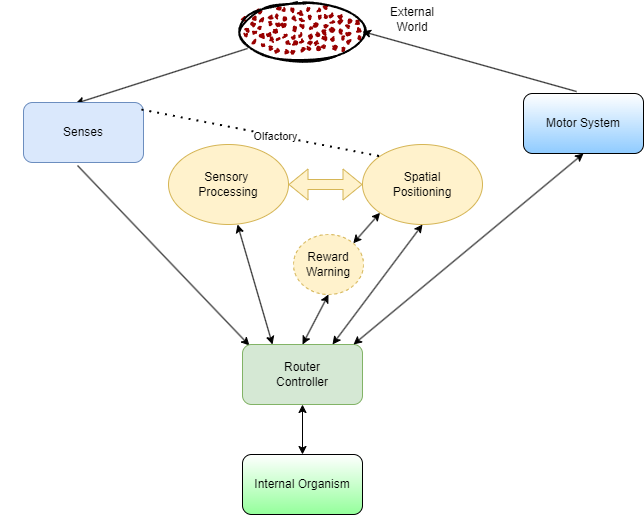
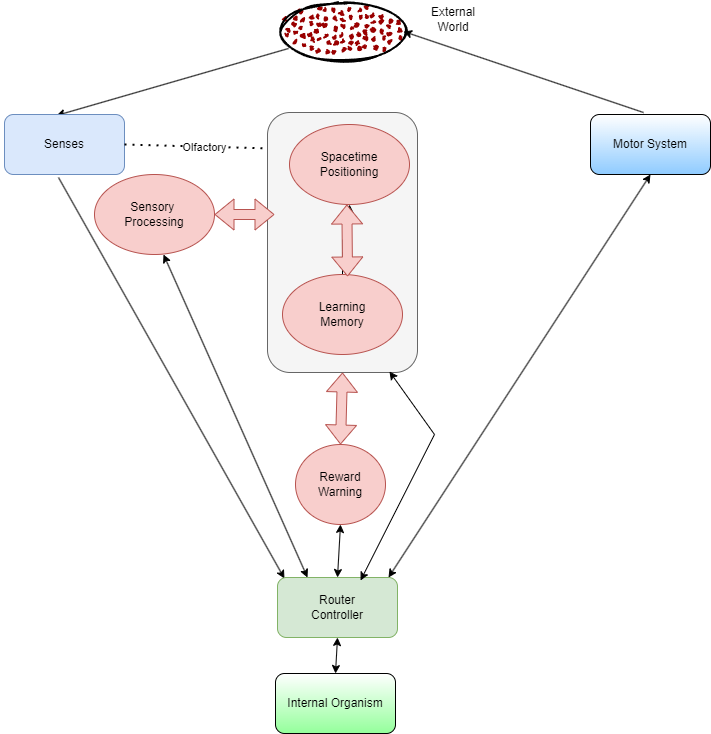
The diagrams are intended to represent processes or more correctly categories of processes. Anatomical structures may not match. While the diagrams are not supposed to map to anatomy, there is a rough correspondence between various anatomical structures and the categories of processes, especially in the more primitive organisms. As brains have become complex, the capabilities expressed by the processes become distributed throughout the brain. This allows not only more sophisticated processes (more neurons involved with a single function), but also redundancy and integration.
Note: The dotted olfactory line in the diagrams is a minor exception to rule that diagrams represent processes, not anatomy., It represent an anatomical fact that the olfactory system does not signal through the router/controller but is connected closely to the spacetime positioning system.
Organism-0
Organism-0 is essentially an organism without information about the external world. It would have a controller brain with information about internal states and influence over the internal organism.
Organism-1
In Organism-1, an ability to interact the environment is added. Information comes from the senses; a smart routing function is added to the controller that enables some nuance in motor system responses that may be relatively hard-wired.
Organism-2
In Organism-2, the router controller is augmented by additional processing between the sense information and motor response. The senses are enhanced by additional processing . A basic spatial positioning system is developed to control mobility. There may have been a nascent reward/warning system that is shown in the diagram as a dotted circle. Sophistication of the networks borders on consciousness.
Organism-3
In Organism-3, consciousness arises from adding:
Space and time positioning
More sophisticated sensory processing
Capacity for learning and memory
A more complete reward/warning system
These are the key elements of consciousness. The reward/warning system ties mentality to the biological organism. Learning and memory requires senses, spacetime positioning, and a reward/warning system as an arbitrator for judging the context and value of actions generated by the motor system. The requirements of complex navigation may been have the evolutionary force that combined these elements. Consider the classic lab test: a mouse finds its way through a maze with its senses, learns the path by storing spacetime stamped memories, and reaches the morsel of reward at the end of the trail.
Organism-4
Organism-4 is an advanced organism such as a mammal or human. Reasoning, problem-solving, and communication capabilities evolve on top of Organism-3.
Summary
Consciousness develops in organisms as an extension of the internal biological control mechanisms through the evolution of capabilities for interacting with the environment. Consciousness is always oriented internally. While we usually think the content of consciousness is a representation of the external world, in fact, all of the content of consciousness is representation of internal biological states. This can be seen from its evolution from the controller in Organism-0. Internal models mimic the external world, but the model is completely a representation of internal states.





 Broad Speculations