
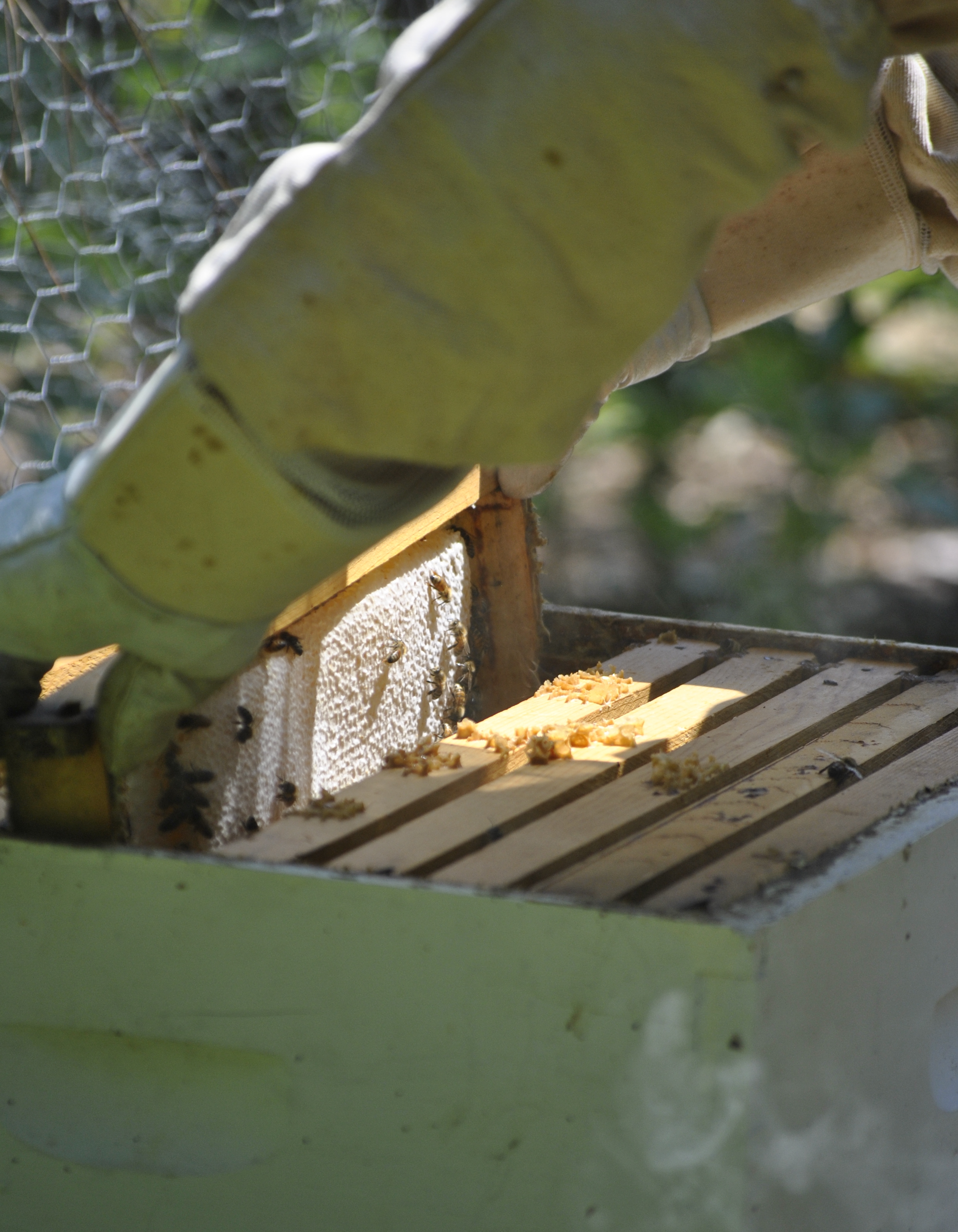
In the Spring of 2005, I became a beekeeper. The idea of keeping bees had been in the back of my mind for many years since a stint in the Peace Corps in Costa Rica in the 1970’s. During that time I worked as an agricultural extension agent and, although my specialty wasn’t beekeeping, there were several beekeepers in the highland coffee region where I worked. I pestered one of them, a man named Vidal, until he agreed to show me his hives. One day I helped him harvest honey and was stung about fifty times from my sloppiness in buttoning my shirt, tying off my pant legs, and tightening straps around the veil. One of the stings was on my eyebrow and my face swelled up like a prizefighter’s after a brutal bout. None of that diminished my interest in beekeeping. So all these years later, in the early evening, I found myself driving southward to pick up a nucleus of bees.
A nucleus is a complete hive with queen, workers, brood, and some honey. My nucleus came with four frames. The frames are wooden rectangles with mounted foundation made from plastic or wax that serve to guide the bees into building the comb in an orderly way that benefits the beekeeper. The techniques of hive and frame construction were invented in the 19th century by Reverend L. L. Langstroth, known as “the father of modern beekeeping.” Langstroth noticed that bees will not bring the surfaces of two combs closer together than about a quarter of an inch. Langstroth constructed hives so the frames were separated from all parts of the hive by a quarter-inch. The result is that the bees build in a manner that allows the beekeeper to remove frames for examination or removal of honey. The same technique is used with little change to today.
After meeting with the breeder named Mike, at dusk, I loaded the four frames encased in a cardboard box in the front seat of my truck and drove back to my house. Once home, I opened the box and the next day placed the frames into their permanent wooden hive that I had nailed together with my crude carpentry skills.
I left the hive alone for several days to allow the hive to acclimate itself to its new home. Eventually the time came to open the hive and take a look at what was going on. I fired up the smoker (for some reason, smoke seems to calm bees), put on the veil, and popped open the top of the hive. Yes, I had bees!
Our view of the bee hive is probably derived more from the Borg of Star Trek than it is from any experience with real bee hives. The Borg arrive in Star Trek the Next Generation as a part cybernetic part biologic organism that lives to assimilate other life forms. They reside in a geometric cube structure and fly through space to announce their intention to any non-Borg: “”We are the Borg. Lower your shields and power down your weapons. Your biological and technological distinctiveness will be added to our own. Resistance is futile. You will be assimilated.” The Borg are all connected via implants to a collective mind and controlled by the Borg Queen. The Borg are eminently successful, constantly in pursue of humans and other intelligent species.
Honey bees, at least the European varieties, unfortunately, are not doing so well. In fact, a considerable portion of us may have never seen a bee hive or even a bee. Decades of pesticides, diseases, and parasites have decimated the honey bee population to such an extent that, in some parts of the country, bees need to imported to pollinate the fruit and vegetable crops. The result is that most urban and suburban environments the only “bees” that are left are wasps and honey bees’ cousins, bumblebees, and carpenter bees. When I first showed my hive to some curious friends, several were surprised at what they saw. Evidently they had expected something more like the big bumblebees that apparently seem to be able to survive in almost any environment.
The honey bee, Apis mellifera, is a different creature altogether. They are smaller and considerably more vigorous in their activity. A fully populated hive can contain upwards of forty thousand bees. As the sun rises and the hive warms, scout bees leave the hive to ascertain the best spots to find nectar, pollen, and water. The scout bees return and tell the forager bees where to go through a elaborate dance that can communicate angle, distance, and target. By midday, bees are shooting off into the sky in all sorts of directions and later returning later return laden with the fruits of their efforts.
Bees come in different races. The most common honey bees are Italian. The first hive I had was Carniolan bees. They are slightly darker than the Italians and reputed to be “friendlier”. African bees are, of course, known for their aggressiveness. What are called African bees in North and South America actually are the unfortunate result of breeding experiment in Brazil that got loose in 1956. Various cross-breed varieties have since then spread over South America, Central America, and into the Southern United States.
The brain of the bee consists of two mushroom shaped lobes of cells. With this limited computing capacity, the bees know when to return to flowers for nectar, how to adjust direction for wind and angle of the sun, and how to read the communications of their fellow bees. The dance of the honey bee, called the waggle dance, seems to be a communication mechanism whereby bees communicate the direction of flowers to other bees. A waggle dance consists of multiple circuits in a complex figure eight pattern.. Although more recent research has called into question research by Karl von Frisch that suggested a high degree of communication in the dance language, the behavior is certainly curious and must serve at least partially some sort of evolutionary advantage.
The intelligent behavior of honey bees certainly challenges our notions about how intelligence works, the prerequisites for it to exist, and what may the limits of biological intelligence. There has always been a presumed relation between brain size and intelligence, but the relationship actually is much more complicated.
Clearly brain size is important in human evolution. As we evolved from our smaller brained ancestors, there seems to be clear indications of greater tool making and with it presumably greater intelligence as the brain got larger. Yet even in the Hominid line, the relation is not completely clear-cut. Neanderthals had brain roughly the same size as Homo sapiens yet do not show an equivalent level of cultural sophistication and tool making. Rare human beings born missing large portions of their brain often are able to live mostly normal lives and learn to speak, reason, make decisions, and in many cases have lives indistinguishable from the others with normal sized brains.
When we cross the species line we find dolphins, whales, and elephants all have brains much larger than humans. While these creatures do show intelligent and highly social behavior, we have no indication any of them are more intelligent than humans.
Part of the explanation is that the brain does much more than think and reason. A good part of the brain, perhaps most of it, is preoccupied with running the organism itself. It may be that our entire sense of consciousness, our sense of individuality, our I-ness, quite possibly is the result of continuous assembly of neural impulses from our sense organs and that all organisms with brains have some degree of self-awareness. It follows, therefore, that organisms with larger bodies would need larger brains simply because they have more sensory inputs that need to be processed to maintain the same level of self-awareness. It also follows that organisms with more complex sensory organs might also have relatively larger brains as, for example, we find in the octopus which seems to have evolved a complex neurological system in part for the support its sophisticated visual and tactile abilities.
Eugene Dubois evolved a formula to relate body mass and brain size. Roughly speaking, as body mass increases brain size increases at the ¾ power. When organisms are plotted on a graph with this relation, they fall somewhere on or near the line that represents this relation. Some organisms fall much above the line which means they extra brain above and beyond the amount required to run the organism. Humans, apes, dolphins, dogs, cats, and squirrels for example fall above the line. Other organisms, such as hippos and horses, fall below which tells us the line does not represent the minimum required for viability. Humans, in fact, fall higher above the line than other organism. This means that we have a lot of extra brain.
The common explanation for this extra brain power is that humans use and need extra neurological resources for reasoning, speech, and language. There is good evidence this is the case. The frontal lobe, which is the center for speech and reasoning, accounts for a good part of the evolutionary more recent development of the brain is large and pronounced in human in contrast to Neanderthals. The reasoning and intelligence requirement may not be the entire explanation for the need extra brain power. It might be that the a portion of this extra brain power is used for additional self-awareness and that this self-awareness in itself have some adaptive advantage. In other words, the degree to which an organism falls above the Dubois line represents in some manner the degree of self-awareness of the organism. Humans, in this case, would be most self-ware of organisms but many other organisms would have a high degree of self-awareness. If we were to compare self-awareness to a digital photograph (I am not implying at all that this self-awareness is totally visual by using this analogy) human self-awareness might be like a 20 megapixel photograph, whereas a cat’s might be 8 megapixel, and that of an ox, which falls well below the Dubois line, might be the kilobyte range.
The degree of self-awareness must have a role to play in the ability of organisms to participate in complex social interactions. Animals above the line all appear to have complex social systems – humans, dolphins, elephants, and even domestic dogs and cats participate in a complex social system with their human owners. Greater self-awareness brings with it the ability to recognize ones self in mirror and a sense of mortality. All of the great apes, including, bonobos, chimpanzees, orangutans, and gorillas, bottlenose dolphins, orcas, elephants, and European Magpies can pass a Mirror Test of self-awareness. I am not implying that animals who do not pass this test are not self-aware, but only that their degree of self-awareness has not reached the same threshold as that of humans and the other animals mentioned above.
So self-awareness seems to be go with greater intelligence, social networking, and extra brain. Intelligence is not the cause of the self-awareness; having extra brain may be the cause of both self-awareness and intelligence. And, self-awareness may be a prerequisite for the development of complex social interactions. Self-awareness, intelligence, and complex social interactions may work in a feedback loop with increasing brain size.
We might speculate self-awareness to work something like this. Our brain and the entire extended neural system receives inputs from the body and the surroundings. In response to the inputs, the neural system (largely the brain but not just the brain) assembles a virtual body that parallels the actual body. It is this virtual body that creates self-awareness or consciousness and allows us to make decisions and act autonomously. In other words, it is the enabler that allows intelligence to operate on our behalf. The phantom limb phenomenon and out-of-body experiences are certainly evidence of this virtual body. And, the belief in a soul and life after death arise from our experience of this virtual body. The larger the brain the more powerful and vivid is this virtual body. This virtual body corresponds to the etheric body or astral body of esoteric philosophy; however, my preference is not to use those terms since they carry with them connotations of additional philosophical beliefs.
The trend toward large brains, greater intelligence, and self-awareness, appears to have some limits. There are some fundamental problems as brains grow, at least as purely biological entities.. One is energy consumption, The operation of the human brain consumes nearly twenty percent of the calories we expend. In newborns, the number is even higher: sixty-five percent. A second problem is communication speed. As brains and neurological systems get larger, the time required to communicate between their different parts increases. Nerve impulses travel fast but not nearly as fast as electrical circuits and a key part of intelligence appears to be related to connections between neurons. If connections take longer, intelligence is less.
Several adaptations have taken place to deal with these problems. One method is specialization. Parts of the brain performing related functions get localized to a smaller part of the brain. By placing functions that need to communicate closer together, the speed problem is reduced. Another method is to compact the brain. In other words, shrink the brain size by increasing the density of the neurons. The key difference in the brains between humans and Neanderthals (and even Homo erectus which in its late evolution sometimes presents brain sizes near the human range) is likely the complexity of the wiring, the density, and internal structure of the brain instead of its total size. What’s more there is even evidence that these sort of changes have likely changed over the course of the human evolution too – the brains of modern human are, in fact, smaller than Cro-Magnon ancestors of a thirty-five thousand years ago.
The possible future evolution of the human neurological system might involve the continuance of some of these same adaptations. In other words, we could have greater specialization or growth in specialized areas such as the frontal lobe associated with speech and reasoning and the temporal lobe associated with memory and religious experiences. Also, greater compaction of neurons could also continue. However, there seems to be some limits to both of these approaches. Increasing the size on one area might require a decrease in another area or the energy usage and cooling requirements of the brain would need to increase. Compaction has limits related to the amount of noise generated as neurons get smaller. Both of these problems are similar to the same problems encountered in reducing the size of transistors.
One way out of this is extend the limits of biology with physics and engineering – in other words, electronic neural implants. This research is in its infancy and has until now been primarily limited to monitoring devices. Eye implants or bionic eyes have been had some success. Cochlear implants, the implants Rush Limbaugh received to correct his hearing loss, have been used on thousands of people and stimulate the auditory nerve to restore hearing. Brain pacemakers, medical devices that stimulate the deep brain, can be used to ease the symptoms of such diseases as epilepsy and Parkinson’s Disease. Direct control of physical devices through implants has already been demonstrated in rats, monkeys, and humans.
We can expect most of the speculations of science fiction to come about in coming decades. We can envision computer and memory chips enhancing reasoning power and storage, direct brain to brain communication in a manner similar to how cell phones are used today, and perhaps an evolution of neural-electronic hybrid network like the Internet through which everyone is connected directly via brain implants. The world of the Borg would become a reality.
The fact is that human societies have already evolved a good deal more hive-like characteristics than is often realized. Millions of years ago even before the evolution of the Hominid line our evolutionary ancestors headed down a path where the survival of the individual of the species began increasingly inter-wound with the survival of the group much as the individual bee cannot survive outside the hive. This is the same path that all social animals have gone down.
Human beings, outside of the insect societies, have become the most hive-like of creatures. Humans live in large population groups of interdependent individuals. We have extreme differentiation of labor with many more specializations than worker, drone, and queen. We defend our groups as vigorously as bees and exhibit the same self-sacrifice in our wars as worker bees do when they give up their lives to sting. We even guard our borders like sentry bees at the entrance to the hive checking returning bees to make certain they belong to their hive.
The critical difference between us and bees, of course, is that these hive-like behaviors in us are not hard-wired biology but rather have been exported to the biological-cultural sphere. As a consequence, we adapt more rapidly and modify ourselves swiftly than other species. Innovations can arise and spread through human society sometimes within weeks and months instead of thousands of years. Our great risk now is that our speed of adoption of innovations may be so great that we may not realize the fatal flaws of some of our innovations.

 Broad Speculations