Don Luis

“…there is nothing more real than dream. This statement only makes sense once it is understood that normal waking life is as unreal as dream, and in exactly the same way.” – Tenzin Wangyal Rinpoche in The Tibetan Yogas of Dream and Sleep

“… do not alter the reality of the dream; do not divorce the magic of the story or the vitality of the myth. Do not forget that rivers can exist without water but not without shores. Believe me reality means nothing unless we can verify it in dreams.”- Don Manuel Cordova (Ino Moxo) speaking in Cesar Calvo’s The Three Halves of Ino Moxo.

Don Luis

Don Luis

The trip from Quito to Tena takes about six hours and involves going up and down the Andes with snow covered volcanoes hovering above and a landslide one hard rain away on the side. The bus, with Braveheart dubbed in Spanish playing on a flat-screen TV in the front, drives half the time on the wrong side of the road and stops constantly to pick up or let off people. It goes 20 miles an hour uphill and 50 miles per hour downhill with the brakes activating every few seconds to avoid plummeting into the ravine on whichever side happens to be the downside of the mountain.

Arriving at Tena, I manage to pick the only taxi driver who doesn’t know where Kuyaloma is. I think it is my Spanish at first but then find he had just moved to Tena from Quito and wasn’t familiar with all the nuances of the area. He goes to ask someone for directions and comes back in a few minutes. Later I discover most of the taxi drivers know Don Luis personally. We drive from Tena to Port Napo, then on a road along the river. After missing the poorly marked turn several times and asking directions, we find a gravel road that leads up to where Don Luis and his family lives.

Don Luis is a traditional healer. He is 58 years old, but extremely fit and athletic. He is also kind, gentle, and, I would say, charismatic. Like most traditional healers of the Upper Amazon he uses ayahausca along with great many other herbs and treatments. His treatment conducted in a ceremony (the term used by Don Luis) is called a cleansing or limpia in Spanish.

The accommodations are humble but more than adequate. Visitors sleep in wooden huts built on concrete slabs with shared showers and toilets. There is a kitchen and eating area several dozen yards away. Don Luis and his extended family live just down the hill. Roosters, hens, and chicks chicks roam around the buildings scratching for whatever food they can find. A pack of relatively well-behaved dogs show up whenever food is served. The ceremonies are conducted in a circular thatched structure with wooden half walls surrounding a fireplace built into the concrete floor. Surrounding the fireplace are wooden benches that are covered with pads for participants.

A late afternoon rain comes down from the Andes and cools off the afternoon heat. Around eight o’clock, we gather and find our places on the benches. The room is lit by a candle and the fire in the floor. The fragrant smell of burning wood fills the air. With Don Luis are his wife, his son Juan, and his son’s wife as helpers. Don Luis takes off his shirt and puts on a large necklace made of teeth, feathers, and beads. He explains what will happen and asks if there are questions.

Don Luis begins by smoking large cigars of a strong, native tobacco. The smoke is blown into the room. He picks up his flute and a robust, almost other worldly, sound comes out. One by one each of us are invited to sit on a small stool in front of him.

The ayahausca is poured from a kettle into a small bowl. Don Luis moves it back and forth and blows smoke over it. Each person drains the bowl slowly then rinses. Shortly Don Luis provides a small piece of ginger to chew.

Juan blows the candle out and the wood on the fire is rearranged to diminish the flame. Only a large pile of glowing embers illuminates the space of the room.

Time passes and not much seems to be happening. I sit wondering how long the ayahausca will stay down. They have provided bowls for the expected throw up. The first thing of significance I notice are the embers in the fire transforming into some sort of bizarre animal – something like a glowing bulldog with misshapen bulging eyes.

The visions come on replacing the room and its space with symbols and bizarre shapes in HD color. They change and evolve quickly almost like the spinning symbols of slot machine never coming to rest. Shortly afterward I vomit. I feel only about 2% of my brain has any contact with my body or where I am. Whether my eyes are open or closed (and half the time I don’t know which) my entire field of vision is filled with images that seem to stream like an incomprehensible message being downloaded into my nervous system. I trust that later I will understand the message.

Don Luis summons me for the limpia. I need to be helped to walk across the floor. I sit in front of him again. He waves feathers or leaves around me. He has been me take off my shirt and sprays a liquid over my chest and back. He then sprays both sides of my hands and tells me to wipe the liquid on my face. Then he tells me to close my eyes. Suddenly he is somewhere over my head and the images are extremely strong. It is almost like Don Luis is guiding the images, but many of them I do not remember after the experience. He plays music on the flute, harmonica, and what I think is a Jew’s harp. Then he sings. The limpia is over. I go back to my seat and the next participant takes a seat on the stool.

Eventually visions start to ease back in intensity. Juan begins giving me lots of water. I begin thinking a lot about my family. I see my older daughter evolving into a young woman having a career and eventually marrying. I see my younger daughter, adopted from Romania, growing in contact with her birth mother and family. I see her holding hands with her mother. My wife and I are left. Everything passes from us. Everything in the world passes. Our friends and relatives die. Our homes are torn down and replaced. Nothing is permanent, but that is the way it is and it is good.

The visions start to dissipate. Eventually I go back to the room but I can´t sleep for a long time. I barely sleep two hours but wake up with a lot of energy.

Two days later I watch the preparation of the ayahausca. Don Luis prepares ayahausca from plants that he cultivates in a sustainable manner on his property.

That night a group of five people from Quito arrive for a ceremony. Don Luis and I both agree to a smaller dose for me.

The ceremony is conducted as before. My first visions are of two fishes or snakes swimming in narrow pools in this giant hall like the baths in Budapest. Everything is in brilliant shades of red, yellow, and orange.

I walk by myself to the stool for the limpia. Instead of 2% in my body, I am more like 10% in my body with the lower dose. The images from the limpia seem familiar as if the same visions are reoccurring with the same songs as the first night. It is as if I am repeating the visions from the first night because I couldn’t remember them- something like a remedial course. I have a vision of a network of membranes or cells pulsating in a box-like structure. I have the distinct impression I am seeing my lungs or kidneys from the inside. Everything is in yellow or white and the cell walls dark red. The next vision is the most profound. During the cleansing when Don Luis plays the harmonica, the song is very sad. Suddenly I remember I had exactly this same experience with the harmonica the first night and had forgotten it. The song is sad because everything including myself is so limited and will pass. So this song is like a funeral song for me. But the song is making fun of me and my self-pity so it is not simply sad, but ironically sad like the proverbial violins. Everything is in purple with something sliding back and forth to the music with this bizarre pattern in the background. Later I have the impression of Don Luis putting something inside me by blowing into my head.

After I return to my seat, a huge thunderstorm brews up outside and serves as a backdrop to the rest of the ceremony. The visions diminish more rapidly with the smaller dose.

During the day we compare experiences and discuss with Don Luis. He tells me during the first night the goddess put two rose-colored diamonds in my head. He thinks the snakes in the pools are a good omen from the second night since his instruction came from the lagoon and his practice is based on its wisdom. I tell him about my thought that he put something inside me and he confirms that he put something in me to give me a control that I needed. He doesn’t elaborate about what sort of control it is.

My scientific side can’t resist analyzing the visions even as they seem so completely believable to me on their own terms. The scientific approach to non-normal cognition usually is to dismiss it or to reduce it to physiology or neurology. Take this quote from recent article: “Contrary to popular belief, research suggests that there is nothing paranormal about these experiences. Instead, near-death experiences are the manifestation of normal brain function gone awry, during a traumatic, and sometimes harmless, event.” (1) The authors go on to cite oxygen deprivation, release of noradrenaline in the mid-brain, and the brain’s attempt to make sense of unusual sensations and perceptions occurring during a traumatic event as possible causes of paranormal experiences.

Michael Persinger has similarly attributed experiences of UFOs and mysterious, sometimes alien, presences weak electromagnetic stimulation of the temporal lobe. He also notes the link between people having religious experience and temporal lobe epilepsy.

During the third ceremony, I follow the transition from no effect to effects. For a while after drinking nothing happens, then things start to become distorted and I sense things are changing, then the transition happens in a moment. Pop!. Suddenly the empty space in front of me becomes a room with blue walls, deep shadows, and faces on the walls. The wall connects to a hall that extends off into some seemingly infinite distance as in a Renaissance painting.

Don Luis sings and twirls something. I sense energy being projected from him in a spiral throughout the room as if I am seeing the sound of his song.

When I shut my eyes cartoon characters prance about. Suddenly a whole room of boats or canoes appears to my right.

During the cleansing, Don Luis appears in the darkness like a psychedelic man in a poster from the sixties. Lines and patterns are across his body, jaguar-like. The experience of the cleansing is different this time – no remedial work. When he says to close my eyes, I am inside of something like a pipe or tunnel, with yellow walls in sharp geometric shapes assembled at irregular angles. The walls seem to pulsate and move and they appear to be driven by creatures in the center of each plane. Each is a living creature with human like face and each seems to be owner and protector of its own wall or plane. However, the creatures have bizarre eyes and noses. They live in a world that is like it would be if our world were turned inside out (or maybe it is the reverse – we live in the inside out of their world).

After the cleansing, I lie down. I look at the ceiling and can see through it into the sky above. Then I am in a marsh and everywhere I look there are eyes through it observing me.

The effects dissipate and I return to my room. Hours pass before sleep comes but again I awake with energy.

What have I seen? Where have I been?

The latest reductionist argument is the phosphene argument. James Kent:

“DMT is stunning in its effect, no doubt. But, like anything, when you do it many times the magic tends to wear off and reveal itself for what it is; an exotic aberration of the brain’s perceptual mechanics…dumping DMT into the perceptual wetworks (sic) is akin to messing with the logic that produces the display on the computer screen you are looking at right now. Any programmer can tell you that a single line of code consisting of only a few characters can drastically alter the way your screen presents the data coming from your video card. It can make the screen flicker, blink, warp, twist, or fall into infinitely recursive fractalline chaos.”(2)

For the sake of argument, let’s agree to the reductionist arguments. Let’s agree there is a physical or neurological part to the visions. We can even say that is all there is. Can’t the same be said of normal cognition, normal vision, and normal perception? For that matter, what is normal? Hidden inside this reductionist approach is a gigantic but unstated assumption that any experience or cognition associated with supposed abnormal brain function is not valid but experience or cognition associated with supposed normal brain function is valid. The experience is dismissed because it associated with physiology or neurology regarded to be not normal.

The problem with this should be obvious particularly to a reductionist. If experience and cognition can be solely explained by physiology and neurology as a reductionist believes, then normal and paranormal experiences are actually on the same footing as to validity.

The fact is that everything we perceive really is phantasma. The red of the rose is not real. It is a particular wavelength of light. The sound of the distant thunder is not real. It is an acoustic wave moving through the air. Solid objects don’t really exist. We might kick a large rock and we might hurt our foot but physics says the rock is mostly empty space and the pain in our foot is the product of a nerve impulse. Our experiences are all in the past, delayed by a neurological time-lag and assembled into a coherent whole bearing perhaps no resemblance to what is actually “out there” in the world. The pattern forming process in the brain/mind mimics the pattern forming forces of nature. We are completely cut off from real cognition. We are trapped in our sensory equipment and the cognitive apparatus of our brain. We make sense of the world only because we are a part of it and constructed as it is constructed. We are from the same pattern forming processes that built the world. Small wonder that mathematics seems to work so well to describe scientifically the world since the mathematical knowledge springs from the same source as the world.

I prepare to leave and say my good-byes. In the taxi back to Tena from Kuyaloma, the radio plays techno music. On the bus back to Quito from Tena, the Transporter movies are playing.

Napusamai Ayahuasca Lodge

Notes

1- Dean Mobbs and Caroline Watt,”There is nothing paranormal about near-death experiences: how neuroscience can explain seeing bright lights, meeting the dead, or being convinced you are one of them”, published in “Trends in Cognitive Sciences Volume 15, Issue 10, 447-449, 18 August 2011.
2- http://www.tripzine.com/listing.php?id=dmt_pickover

Posted in Ayahuasca, DMT | 12 Comments

On the Run

In “The Running Man” movie, Arnold Schwarzenegger plays an innocent man who has been convicted of a crime and sentenced to participate in TV reality show where criminals run and try to evade pursuers trying to kill them. With our growing obesity problem and decreasing physical activity, this dystopian movie probably tells us little about our future; however, it may tell us a something about our past. Evidence is accumulating that running, in fact, may have played a key role in our evolution. In other words, running human may be as important as thinking human or speaking human.

Bipedalism has been recognized for a long time as a key human feature and a feature of somewhat inexplicable origins. The general theory goes something like this. Our ancestors were primarily arboreal but a branch of them perhaps developed a slightly enhanced ability to walk upright. This happened probably more than seven million years ago and long before the Homo genus of ancestors came into being. The advantages to walking upright on the ground are a better ability to spot adversaries and potential predators. In addition, freeing the hands makes usage of tools possible. The sort of tools we are talking about at this time were primarily found objects like sticks and stones perhaps with a bare minimum of enhancement. Gradually as the climate changed the arboreal environment retreated to be replaced by plains with scattered trees and grasses. Primates walking upright could adapt to this environment. So these tendencies probably already present became more pronounced. What is more our diet began to change. It had to change because the readily available fruit from the forests became more scattered and harder to find. We began to incorporate hard tubers into our diets. As a consequence, our ancestors initially developed large teeth and jaws and then later as the plains began to spread even more extensively we began to add meat to our diet and the jaws and teeth began to shrink leading us eventually to the omnivorous humans we are today.

Daniel Lieberman carries this theory one step (or should we say many steps) further and believes not only did our ancestors develop an increased ability to walk upright but we also became runners, specifically endurance runners. “The fossil evidence of these features suggests that endurance running is a derived capability of the genus Homo, originating about 2 million years ago, and may have been instrumental in the evolution of the human body form.”

Many human characteristics that distinguish us from other primates may be adaptions for endurance running: springy Achilles tendon, stout leg-joints, lack of hair, tendency to sweat to dissipate heat., the large canals of the inner ear needed for balance required to coordinate the running motion, and our large buttocks.

So why were we running? Hunting and scavenging were certainly important factors. The ability to run down an injured or wounded animal or to get to a lion kill before the hyenas had devoured the remains would be advantages. We can also envision that humans probably lived in small semi-nomadic bands during this time. The location of each camp needed to be optimized for hunting, gathering of plants and fruits, and retrieving water. The ability to cover efficiently greater distances in the same amount of time would effectively expand the area in range of a camp and provide access to a greater amount of resources.

My own interest in running goes back to the time when I used to watch ABC’s Wide World of Sports on television. I especially remember watching on television an American, Jim Beatty, breaking the four minute barrier in the indoor mile. Sometime after that I began to run myself pounding out multiple (but slow) miles in long pants and tennis shoes. This was long before the running boom and in an era where runners were regarded to be somewhat eccentric. Running appealed to me as a solitary activity that complemented my introverted nature. Of course, I had no idea how to train and after running many slow long distance miles a completely untrained friend easily defeated me in a short race. Later I went on to meager success running track in high school before temporarily abandoning running for various intellectual pursuits.

I am not blessed with a great deal of natural ability for running. My fast-twitch and slow-twitch muscles seem to be a perfect ratio to guarantee that I am too slow to be a sprinter and have too little endurance to be a good distance runner. My best relative times are for middle distances (800 meters and mile) but even those times are nothing to brag about. The plus side, I guess, of this general lack of ability is that I have been relatively injury free for my entire running career.

I picked up with running again while I was in the Peace Corps. The motive then was simple fitness. My training for the first two or three years consisted simply of one, fairly fast mile followed by some calisthenics from a Royal Canadian Air Force fitness routine done four or five times a week. It is actually amazing the level of fitness which can be achieved with a simple but consistent program. Returning to the States, I discovered one day I could easily run more than a mile simply by slowing my pace slightly. I began to get some books on training and real running shoes. Soon I was logging thirty or more miles a week and participating in road races.

Another vivid memory from youth was Abebe Bikila running barefoot in the 1960 Olympic Marathon in Rome. I had an opportunity to race barefoot once in high school. In that time, many of the high schools where I grew up placed such little emphasis on track that they actually did not have a track. One high school ran their races on half mile horse track where runners needed to be careful not to twist an ankle on the dried clods and hoof prints from the horses training on the track. Other schools simply marked out a quarter oval on the grass of a field. On one of those tracks one wet day I slipped my shoes off and discovered that I felt absolutely great running without shoes. I competed that day without shoes and recorded my best high school time for the mile (once again nothing to really brag about but still good for me at the time).

The idea of going minimalist always appealed to me but I couldn’t conceive of being able to run on concrete and asphalt without shoes. And shoes generally meant something relatively heavy and padded. Every time I went to the shoe store, the “experts” would try to guide me to the big shoes with the heavy tread and thick padding but I would insist on the lightest thing I could find in spite of jaundiced looks and dire warnings from sales people.

After thirty some years of enduring regular running shoes, I discovered the Vibram Five Fingers and also discovered basically that I needed to completely relearn how to run. That is, I needed to learn how to run like humans evolved to run without thick artificial padding, rubber heels, and heavy counterweights on the feet to distort the stride into something the primate human would never have done. The Five Fingers shoes might be best described as a modest layer of rubber you strap on your feet that protects your feet from glass and sharp objects but provides little additional padding. Your feet strike whatever surface you are on with mostly full force so you need to learn to run as lightly as possible with short quick strides that land closer to the front of the foot than the heel to toe style often explained the running books. The learning curve was steep. I began to use tendons and muscles that had been unused or misused for years and my running seemed to take a step back. Eventually I worked through that stage and can’t imagine returning to regular running shoes which now feel extraordinarily heavy and awkward. The Five Fingers haven’t transformed me into a world class runner but they may have extended my running career.

Lieberman has a website at Harvard for anyone interested in the biomechanics of running barefoot or in minimal footwear.

Overlooked in the much of the discussion of the physical evolution of bipedalism is an important side effect. As M. Maurice Abitbol pointed out in “Obstetrics and posture in pelvic anatomy”: “The pelvis in Australopithecus was shaped more to satisfy erect posture and bipedal locomotion than to allow increase in fetal size, which occurred much later, since the encephalization process was on the way only after the pelvis had taken more or less its present shape. Adjustments of the human female pelvis to the increased size of the fetal head are minor, compared with the adjustments to erect posture, because erect posture preceded encephalization and was therefore first to make its demands on the pelvis.”

As a consequence of this, the increase in brain size during human evolution carried with it the corollary effect of relative neurological underdevelopment of humans at birth. For example, a colt can stand almost immediately after birth whereas a human requires typically a year or more to stand even unsteadily. The human, thus, requires extended care of parents until the teenage years. This has had wide and profound impact on human social evolution and development of marriage and the extended family.

The human brain at birth is underdeveloped. The new born is helpless and completely dependent on parents. Geza Roheim, the founder of the field of psychoanalytic anthropology, believed that much of human psychology come from this prolonged dependence on maternal care. Human ego functions reflect the long period of human infancy and the bond created develops into a necessary emotional and social tie that forces humans to attain and maintain continuous relationships with other people.

Even aside from any psychoanalytic theories, it is clear that much of our social structure evolved to care for infants. So running human relates directly to social human.

Posted in Brain size, Human Evolution, Running | 4 Comments

Into the Hive

In the Spring of 2005, I became a beekeeper. The idea of keeping bees had been in the back of my mind for many years since a stint in the Peace Corps in Costa Rica in the 1970’s. During that time I worked as an agricultural extension agent and, although my specialty wasn’t beekeeping, there were several beekeepers in the highland coffee region where I worked. I pestered one of them, a man named Vidal, until he agreed to show me his hives. One day I helped him harvest honey and was stung about fifty times from my sloppiness in buttoning my shirt, tying off my pant legs, and tightening straps around the veil. One of the stings was on my eyebrow and my face swelled up like a prizefighter’s after a brutal bout. None of that diminished my interest in beekeeping. So all these years later, in the early evening, I found myself driving southward to pick up a nucleus of bees.

A nucleus is a complete hive with queen, workers, brood, and some honey. My nucleus came with four frames. The frames are wooden rectangles with mounted foundation made from plastic or wax that serve to guide the bees into building the comb in an orderly way that benefits the beekeeper. The techniques of hive and frame construction were invented in the 19th century by Reverend L. L. Langstroth, known as “the father of modern beekeeping.” Langstroth noticed that bees will not bring the surfaces of two combs closer together than about a quarter of an inch. Langstroth constructed hives so the frames were separated from all parts of the hive by a quarter-inch. The result is that the bees build in a manner that allows the beekeeper to remove frames for examination or removal of honey. The same technique is used with little change to today.

After meeting with the breeder named Mike, at dusk, I loaded the four frames encased in a cardboard box in the front seat of my truck and drove back to my house. Once home, I opened the box and the next day placed the frames into their permanent wooden hive that I had nailed together with my crude carpentry skills.

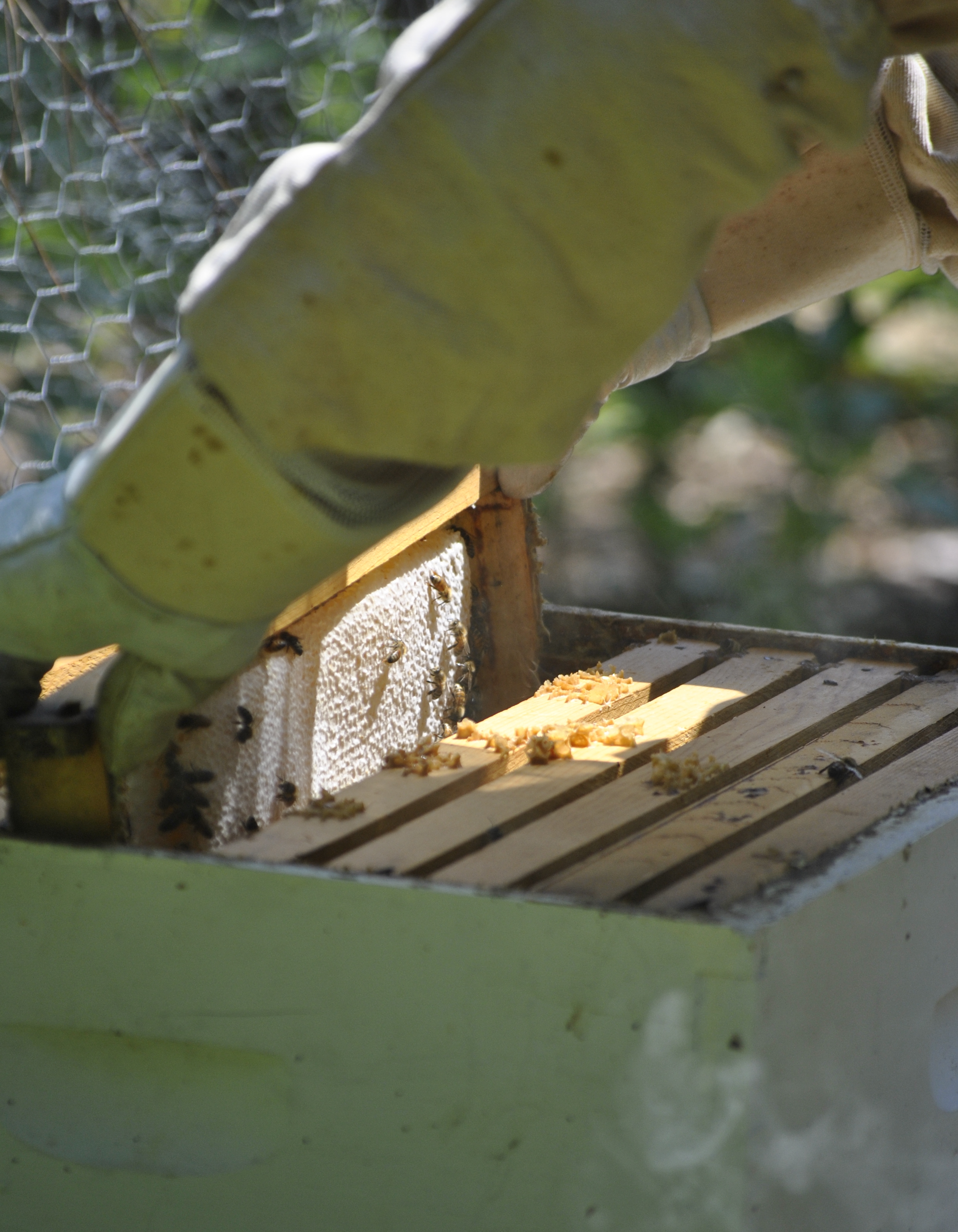
I left the hive alone for several days to allow the hive to acclimate itself to its new home. Eventually the time came to open the hive and take a look at what was going on. I fired up the smoker (for some reason, smoke seems to calm bees), put on the veil, and popped open the top of the hive. Yes, I had bees!

Our view of the bee hive is probably derived more from the Borg of Star Trek than it is from any experience with real bee hives. The Borg arrive in Star Trek the Next Generation as a part cybernetic part biologic organism that lives to assimilate other life forms. They reside in a geometric cube structure and fly through space to announce their intention to any non-Borg: “”We are the Borg. Lower your shields and power down your weapons. Your biological and technological distinctiveness will be added to our own. Resistance is futile. You will be assimilated.” The Borg are all connected via implants to a collective mind and controlled by the Borg Queen. The Borg are eminently successful, constantly in pursue of humans and other intelligent species.

Honey bees, at least the European varieties, unfortunately, are not doing so well. In fact, a considerable portion of us may have never seen a bee hive or even a bee. Decades of pesticides, diseases, and parasites have decimated the honey bee population to such an extent that, in some parts of the country, bees need to imported to pollinate the fruit and vegetable crops. The result is that most urban and suburban environments the only “bees” that are left are wasps and honey bees’ cousins, bumblebees, and carpenter bees. When I first showed my hive to some curious friends, several were surprised at what they saw. Evidently they had expected something more like the big bumblebees that apparently seem to be able to survive in almost any environment.

The honey bee, Apis mellifera, is a different creature altogether. They are smaller and considerably more vigorous in their activity. A fully populated hive can contain upwards of forty thousand bees. As the sun rises and the hive warms, scout bees leave the hive to ascertain the best spots to find nectar, pollen, and water. The scout bees return and tell the forager bees where to go through a elaborate dance that can communicate angle, distance, and target. By midday, bees are shooting off into the sky in all sorts of directions and later returning later return laden with the fruits of their efforts.

Bees come in different races. The most common honey bees are Italian. The first hive I had was Carniolan bees. They are slightly darker than the Italians and reputed to be “friendlier”. African bees are, of course, known for their aggressiveness. What are called African bees in North and South America actually are the unfortunate result of breeding experiment in Brazil that got loose in 1956. Various cross-breed varieties have since then spread over South America, Central America, and into the Southern United States.

The brain of the bee consists of two mushroom shaped lobes of cells. With this limited computing capacity, the bees know when to return to flowers for nectar, how to adjust direction for wind and angle of the sun, and how to read the communications of their fellow bees. The dance of the honey bee, called the waggle dance, seems to be a communication mechanism whereby bees communicate the direction of flowers to other bees. A waggle dance consists of multiple circuits in a complex figure eight pattern.. Although more recent research has called into question research by Karl von Frisch that suggested a high degree of communication in the dance language, the behavior is certainly curious and must serve at least partially some sort of evolutionary advantage.

The intelligent behavior of honey bees certainly challenges our notions about how intelligence works, the prerequisites for it to exist, and what may the limits of biological intelligence. There has always been a presumed relation between brain size and intelligence, but the relationship actually is much more complicated.

Clearly brain size is important in human evolution. As we evolved from our smaller brained ancestors, there seems to be clear indications of greater tool making and with it presumably greater intelligence as the brain got larger. Yet even in the Hominid line, the relation is not completely clear-cut. Neanderthals had brain roughly the same size as Homo sapiens yet do not show an equivalent level of cultural sophistication and tool making. Rare human beings born missing large portions of their brain often are able to live mostly normal lives and learn to speak, reason, make decisions, and in many cases have lives indistinguishable from the others with normal sized brains.

When we cross the species line we find dolphins, whales, and elephants all have brains much larger than humans. While these creatures do show intelligent and highly social behavior, we have no indication any of them are more intelligent than humans.

Part of the explanation is that the brain does much more than think and reason. A good part of the brain, perhaps most of it, is preoccupied with running the organism itself. It may be that our entire sense of consciousness, our sense of individuality, our I-ness, quite possibly is the result of continuous assembly of neural impulses from our sense organs and that all organisms with brains have some degree of self-awareness. It follows, therefore, that organisms with larger bodies would need larger brains simply because they have more sensory inputs that need to be processed to maintain the same level of self-awareness. It also follows that organisms with more complex sensory organs might also have relatively larger brains as, for example, we find in the octopus which seems to have evolved a complex neurological system in part for the support its sophisticated visual and tactile abilities.

Eugene Dubois evolved a formula to relate body mass and brain size. Roughly speaking, as body mass increases brain size increases at the ¾ power. When organisms are plotted on a graph with this relation, they fall somewhere on or near the line that represents this relation. Some organisms fall much above the line which means they extra brain above and beyond the amount required to run the organism. Humans, apes, dolphins, dogs, cats, and squirrels for example fall above the line. Other organisms, such as hippos and horses, fall below which tells us the line does not represent the minimum required for viability. Humans, in fact, fall higher above the line than other organism. This means that we have a lot of extra brain.

The common explanation for this extra brain power is that humans use and need extra neurological resources for reasoning, speech, and language. There is good evidence this is the case. The frontal lobe, which is the center for speech and reasoning, accounts for a good part of the evolutionary more recent development of the brain is large and pronounced in human in contrast to Neanderthals. The reasoning and intelligence requirement may not be the entire explanation for the need extra brain power. It might be that the a portion of this extra brain power is used for additional self-awareness and that this self-awareness in itself have some adaptive advantage. In other words, the degree to which an organism falls above the Dubois line represents in some manner the degree of self-awareness of the organism. Humans, in this case, would be most self-ware of organisms but many other organisms would have a high degree of self-awareness. If we were to compare self-awareness to a digital photograph (I am not implying at all that this self-awareness is totally visual by using this analogy) human self-awareness might be like a 20 megapixel photograph, whereas a cat’s might be 8 megapixel, and that of an ox, which falls well below the Dubois line, might be the kilobyte range.

The degree of self-awareness must have a role to play in the ability of organisms to participate in complex social interactions. Animals above the line all appear to have complex social systems – humans, dolphins, elephants, and even domestic dogs and cats participate in a complex social system with their human owners. Greater self-awareness brings with it the ability to recognize ones self in mirror and a sense of mortality. All of the great apes, including, bonobos, chimpanzees, orangutans, and gorillas, bottlenose dolphins, orcas, elephants, and European Magpies can pass a Mirror Test of self-awareness. I am not implying that animals who do not pass this test are not self-aware, but only that their degree of self-awareness has not reached the same threshold as that of humans and the other animals mentioned above.

So self-awareness seems to be go with greater intelligence, social networking, and extra brain. Intelligence is not the cause of the self-awareness; having extra brain may be the cause of both self-awareness and intelligence. And, self-awareness may be a prerequisite for the development of complex social interactions. Self-awareness, intelligence, and complex social interactions may work in a feedback loop with increasing brain size.

We might speculate self-awareness to work something like this. Our brain and the entire extended neural system receives inputs from the body and the surroundings. In response to the inputs, the neural system (largely the brain but not just the brain) assembles a virtual body that parallels the actual body. It is this virtual body that creates self-awareness or consciousness and allows us to make decisions and act autonomously. In other words, it is the enabler that allows intelligence to operate on our behalf. The phantom limb phenomenon and out-of-body experiences are certainly evidence of this virtual body. And, the belief in a soul and life after death arise from our experience of this virtual body. The larger the brain the more powerful and vivid is this virtual body. This virtual body corresponds to the etheric body or astral body of esoteric philosophy; however, my preference is not to use those terms since they carry with them connotations of additional philosophical beliefs.

The trend toward large brains, greater intelligence, and self-awareness, appears to have some limits. There are some fundamental problems as brains grow, at least as purely biological entities.. One is energy consumption, The operation of the human brain consumes nearly twenty percent of the calories we expend. In newborns, the number is even higher: sixty-five percent. A second problem is communication speed. As brains and neurological systems get larger, the time required to communicate between their different parts increases. Nerve impulses travel fast but not nearly as fast as electrical circuits and a key part of intelligence appears to be related to connections between neurons. If connections take longer, intelligence is less.

Several adaptations have taken place to deal with these problems. One method is specialization. Parts of the brain performing related functions get localized to a smaller part of the brain. By placing functions that need to communicate closer together, the speed problem is reduced. Another method is to compact the brain. In other words, shrink the brain size by increasing the density of the neurons. The key difference in the brains between humans and Neanderthals (and even Homo erectus which in its late evolution sometimes presents brain sizes near the human range) is likely the complexity of the wiring, the density, and internal structure of the brain instead of its total size. What’s more there is even evidence that these sort of changes have likely changed over the course of the human evolution too – the brains of modern human are, in fact, smaller than Cro-Magnon ancestors of a thirty-five thousand years ago.

The possible future evolution of the human neurological system might involve the continuance of some of these same adaptations. In other words, we could have greater specialization or growth in specialized areas such as the frontal lobe associated with speech and reasoning and the temporal lobe associated with memory and religious experiences. Also, greater compaction of neurons could also continue. However, there seems to be some limits to both of these approaches. Increasing the size on one area might require a decrease in another area or the energy usage and cooling requirements of the brain would need to increase. Compaction has limits related to the amount of noise generated as neurons get smaller. Both of these problems are similar to the same problems encountered in reducing the size of transistors.

One way out of this is extend the limits of biology with physics and engineering – in other words, electronic neural implants. This research is in its infancy and has until now been primarily limited to monitoring devices. Eye implants or bionic eyes have been had some success. Cochlear implants, the implants Rush Limbaugh received to correct his hearing loss, have been used on thousands of people and stimulate the auditory nerve to restore hearing. Brain pacemakers, medical devices that stimulate the deep brain, can be used to ease the symptoms of such diseases as epilepsy and Parkinson’s Disease. Direct control of physical devices through implants has already been demonstrated in rats, monkeys, and humans.

We can expect most of the speculations of science fiction to come about in coming decades. We can envision computer and memory chips enhancing reasoning power and storage, direct brain to brain communication in a manner similar to how cell phones are used today, and perhaps an evolution of neural-electronic hybrid network like the Internet through which everyone is connected directly via brain implants. The world of the Borg would become a reality.

The fact is that human societies have already evolved a good deal more hive-like characteristics than is often realized. Millions of years ago even before the evolution of the Hominid line our evolutionary ancestors headed down a path where the survival of the individual of the species began increasingly inter-wound with the survival of the group much as the individual bee cannot survive outside the hive. This is the same path that all social animals have gone down.

Human beings, outside of the insect societies, have become the most hive-like of creatures. Humans live in large population groups of interdependent individuals. We have extreme differentiation of labor with many more specializations than worker, drone, and queen. We defend our groups as vigorously as bees and exhibit the same self-sacrifice in our wars as worker bees do when they give up their lives to sting. We even guard our borders like sentry bees at the entrance to the hive checking returning bees to make certain they belong to their hive.

The critical difference between us and bees, of course, is that these hive-like behaviors in us are not hard-wired biology but rather have been exported to the biological-cultural sphere. As a consequence, we adapt more rapidly and modify ourselves swiftly than other species. Innovations can arise and spread through human society sometimes within weeks and months instead of thousands of years. Our great risk now is that our speed of adoption of innovations may be so great that we may not realize the fatal flaws of some of our innovations.

Posted in Brain size, Hive, Human Evolution | 3 Comments