
Introduction
The location of the neural correlates of consciousness (NCC) has been the subject of research and philosophical speculation for many decades. The starting assumption for much of this research is that consciousness is a product of brain activity. While there are many good reasons to believe this assumption is correct, the location of NCC in the brain has remained a mystery. A recent competition organized by the Templeton Foundation pitted two widely held theories about NCC against each other and performed research designed to demonstrate the validity of the theories. The theories made claims about how consciousness works and each predicted observations that the research would uncover to prove its theory correct. The global neuronal workspace theory (GNWT) says that consciousness integrates information in a workspace in areas of the brain involved with cognition. The integrated information theory (IIT) says consciousness is a product of a neural network that integrates information. The end results were disappointing with no clear winner, although each side claimed partial victories and had reasons for why their theory was not thoroughly vindicated.
Different speculations on the location of NCC have placed consciousness in various locations scattered all over the brain. Descartes and some mystical traditions believed the pineal gland located in the middle of the brain to be the seat of the soul. Crick and Koch at one time suggested the claustrum as a candidate for a master conductor that might play a major role in consciousness. Mark Solms has proposed the brainstem as a source of consciousness. Most contemporary theories can be divided between theories favoring the front part of the brain where higher order mental activities seem to take place and whole brain theories that include sensory processing centers as part of the information grid where consciousness resides. The lack of definitive results for any of these theories has led some philosophers to propose that consciousness does not reside in the brain. Some have proposed higher dimensions are involved. Others have proposed consciousness as a component of all matter to solve the mystery. Others still have invoked quantum mechanics or other exotic physical phenomena as the source of consciousness.
The lack of evidence for a location or definitive process in the brain for consciousness is a puzzle for neuroscientists. Common to most scientific theories is that our consciousness is an integrated, unified phenomenon. On this basis, the logic follows that consciousness must have a place or at least a mechanism that integrates it; that is, it must have a place in the brain where everything comes together. A notable exception to this is the multiple drafts model of consciousness proposed by Daniel Dennett which explicitly says consciousness has no one place. Unfortunately, Dennett’s model as proposed has no actual role for consciousness nor any proposal for why it exists or how it works.
Maybe consciousness despite all appearances and beliefs is not as integrated or whole as it appears. Instead of a location or process, consciousness could, in fact, be distributed across nodes in dozens of locations in the brain at any point in time.
Is Consciousness Integrated?
The “binding problem” and “combination problem” are closely related issues in theories of mind. They address the problem of how all contents of consciousness – memories, thoughts, perceived objects, emotions – become bound into a single experience. If the integration of consciousness is more illusory than real, there would be no binding problem. While the combination problem has been used in recent years as an objection to panpsychism, it is still much the same problem that begins from an erroneous assumption that consciousness is unified. The answer to both problems is that consciousness is not a single experience but many experiences that happen around the same time. Let us examine reasons why consciousness may appear unified even though it is not.
1- Consciousness seems whole and integrated in large part because we seem to view the world from a perspective.
This perspective, pejoratively called the Cartesian Theatre, arises in part as conscious experiences in parts of the brain involved with reasoning and sense of self. In other words, there are specific conscious experiences at specific locations in the brain that account for the feeling. Some of the areas that have been identified include the medial prefrontal cortex, the medial posterior parietal cortex, the posterior and anterior cingulate cortex, and media ventral medial prefrontal cortex. If this sense of perspective arises from specific parts of the brain, rather than proving consciousness is integrated, it could be evidence for fragmented consciousness with the nuanced sense of self manifesting by conscious experience at multiple locations.
2- The brain routes information from one conscious node to another quickly enough that we do not perceive a lag time; hence, everything appears to be happening together.
Since the experiments of Benjamin Libet in the 1970’s, we have understood there are delays in the brain. Libet discovered evidence of brain activity associated with a conscious decision occurred several hundred milliseconds before there seemed to be conscious awareness of the decision. While there is still debate about the free will issues raised by Libet’s experiments, there is no doubt that delays happen in the brain. Even though neural signals are propagated quickly, they are not instantaneous. In addition, once signals are transmitted from one part of the part to another, additional delays can occur before the electrical activity has built to the point that a conscious experience is registered.
3- Since the content of consciousness frequently contains information from the surrounding environment, many events in consciousness could appear to be happening synchronously because it is happening synchronously in the environment.
Much of conscious experience involves the external world. Events in the external world occur in a natural order with events following each other causally. These events we perceive through our senses which are monitoring the world while we are awake. If we see a book fall from a shelf, we will perceive it striking the floor at about the same time we hear it striking the floor because these events are occurring nearly synchronously with each other. No integration in the brain is required in this case for there to be a feeling that the two experiences of seeing and hearing are integrated because they would be caused by an external stimuli.
4- Information from the senses may reach consciousness fully formed and integrated to itself.
Information from the senses, especially vision, could reach consciousness mostly integrated. The reason we see an orderly and structured world about us is because unconscious processes from the senses to the visual cortex have already assimilated the information and provided an order to our visual perception of the world. By the time, the information emerges as consciousness it is already fully formed and unified. Simply because one sense appears unified does not require that all consciousness be unified.
5- Large scale neural oscillations occurring throughout the brain serve as a kind of timing mechanism much like a conductor keeps the members of an orchestra playing together.
Following the discovery of the default mode network, interest among researchers has increased in studying resting state brain oscillations. Slow self-initiated oscillations characterize both the sleeping and awake brain. In the awake brain, they appear to provide master coordination functions operating on timescales of seconds to hours. They can also generate brain activity that leads to conscious experience. Since the generation of these conscious experiences is partially under the influence of controlling oscillations, they would also be, and appear to be, integrated. A memory of a pleasant experience the day before might lead to a reimagining of the same experience. The reimagining of the memory seems to flow from the original experience in an integrated fashion, but they are casually linked by the underlying resting state oscillations.
6- The brain integrates information, but it does not require consciousness itself to be similarly integrated.
Consciousness may play a role in information flow in the brain through its interactions with unconscious processes without needing itself to be integrated. Consciousness bubbles up from unconscious processes and integrates with other neuron clusters through unconscious processes. No instance of consciousness would have more than a portion of an organism’s total consciousness.
Fragmented Consciousness
The human brain contains over 80 billion neurons with possibly more than a trillion connections between more than a thousand different types of neurons. Neurons on average have an estimated thousand connections to other neurons. The brain’s neural network is a complex biological network with a distinctive type of organization called small-world because it allows connections with few hops between any two neurons while minimizing overhead. Small-world networks are characterized by nodes with many connections to nearby, local nodes and many fewer connections with distant, remote nodes.
This type of network minimizes wiring while still allowing any node to reach any other node with a small number of hops. It segregates tightly integrated processing locally while providing loose integration across clusters of nodes. The resulting network supports both efficient information segregation and integration while using low energy and reduced wiring. Since connections are believed to be crucial to how the brain handles information, it follows from the small-world network organization that information is widely distributed across the brain, but its processing is concentrated in local clusters of neurons. The smaller number of connections between tightly connected local clusters and remote clusters means that the amount of information transmitted between them is relatively small compared to the amount of information processed locally within the cluster.
This suggests the brain performs intensive information processing in small clusters of neurons but only has a form of loose integration across them. A rough analogy might be to a large but decentralized organization of small local committees of people with minimal top-down controls such as a disorganized political party or service organization. Local committees meet and discuss intensively local conditions, but only high-level information and decisions get communicated between the different local groups. People exchange information across groups to a degree. Occasionally a committee will unify around a particular message and issue a communique to the other groups. A national organization might also have its own different internal groups and organizational units and might serve to set general objectives for the local groups but, for the most part, the local groups operate semi-autonomously.
Applying this analogy to an idealized model of the brain, we would find hundreds of clusters of neurons that could potentially manifest consciousness, but that only a relatively small percentage of these clusters would be active in doing so it around the same time. Clusters might range in size from as few as a few hundred neurons to perhaps a million. Each cluster or node could function unconsciously as well. Other clusters still might never be potentially capable of consciousness by virtue of their composition and/or the nature of the function performed. Multiple causal chains from both conscious and unconscious clusters could cause consciousness to arise at a point in the brain.
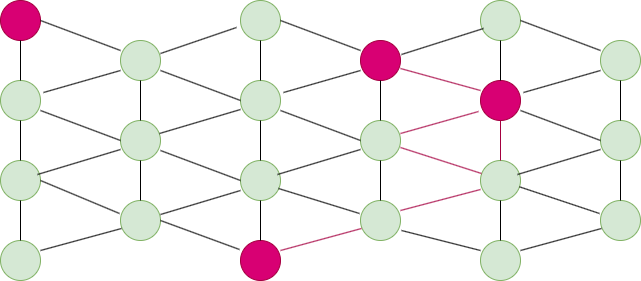
Figure 1 Fragmented Consciousness – Red clusters are conscious; green ones are unconscious. The lines show connectivity between clusters. The red lines show a hypothetical causal pathway between conscious clusters using hops through unconscious clusters.
Each cluster of neurons is acting on its own behalf but is receiving information from other clusters. Underlying the conscious parts of the brain is a vast network of unconscious neural clusters and processes. This is a complex peer to peer network between clusters of neurons where each cluster reacts to information from other clusters or sensory neurons.
In this model, there is little or no essential difference between phenomenal consciousness and what has been termed access consciousness even though both forms of experience seem quite different. Phenomenal consciousness is associated with somewhat raw sensory data. Access consciousness has been associated with high level functions like reasoning and decision making. The key difference between the two in this model is the nature of their inputs. Sensory data comes into the brain from sensory neurons that are interacting with stimuli in the environment. Phenomenal consciousness reflects its sensory input. Access consciousness, on the other hand, is receiving its input not only from parts of the brain involved in sensory information processing, but other centers involving memory and internal feelings. Access consciousness reflects its input, but is several hops removed from sensory data. In the case of both phenomenal and access consciousness, neural clusters are reacting to their individual input which is coming from other neurons.
The human brain has dozens, maybe hundreds, of units performing discrete functions. Each functional unit engages in non-conscious processing. Some, perhaps a large number, of these units may be consciousness capable; however, at any point in time, only a subset of these units will be generating consciousness. The critical processing that produces the contents of consciousness has well-known locations in the brain. These locations have been identified when damage or abnormalities have resulted in a loss of function or anomalous function or through direct electrical or electromagnetic stimulation of an area. The visual cortex in the occipital lobe of the cerebral cortex processes visual information. The auditory cortex in the temporal lobe processes sound. The cortical homunculus discovered by Wilder Penfield is a distorted sensory map of the human body. The frontal cortex is tied to reasoning and higher-level cognition. Damage to almost any part of the brain usually creates a deficit of capability with a diminishment of overall consciousness. The implication of this is that consciousness may be tied to functional areas. Fine nuances even to logical thought might have associated components in types of consciousness.
The most parsimonious hypothesis for the location of consciousness is that it appears in the location where the critical processing occurs. This would mean that it is scattered throughout the brain, not at a single location, and that whatever integration of information occurring in the brain arises largely from unconscious processing. The brain does integrate information, but consciousness is not directly involved.
Implications
Modern neuroscience and philosophy have been derailed in investigating the physical correlates of consciousness because they have labored under the mistaken assumption that consciousness is unified and must be found in a limited number of places in the brain. If consciousness is found all over the brain, then investigations need to focus on smaller clusters of neurons and find commonalities across the clusters that are associated with consciousness.
The fragmented consciousness hypothesis is that consciousness can arise in a relatively small number of neurons, perhaps as few as several hundred, and the totality of consciousness of organism is simply the complete set of its discrete conscious experiences (ce1, ce2, …).
C = {ce1, ce2, ce3, ce4 …}
A key question would be why a cluster would become conscious if it was able to process unconsciously.
One possible explanation is that the information the neuron cluster has received is in some way anomalous or out of bounds of previous information. Perhaps when information falls outside the expected range it needs to be prioritized. Consciousness may be what happens whenever one part of the brain finds something interesting enough that it alerts other parts of the brain about it. Whether other parts of the brain care about the information depends upon their own unique processing and the inputs they receive from other clusters. So, one possible explanation is that a cluster becomes conscious when it needs to provide a more detailed and/or higher priority message to other neuron clusters. In this scenario, there may be routine, low band-width messages routing between cluster all the time, but once consciousness enters the picture, the messages are high priority and high bandwidth.
A second reason may be tied to memory and learning. Since learning has been associated with consciousness and learning at the neural level involves modifying connectivity, it would be logical that consciousness is doing something critical associated with wiring and adaptation at the neural level. If consciousness is tied to learning, then we would expect it to be happening at precisely at the point where the modifications to connectivity need to occur – that is, spread across the brain at the cluster level. This would imply that anything conscious is capable of being remembered; however, whether it is remembered and for how long would depend on possibly the strength of the signal either generated in the cluster itself or in the strength of the signals coming from the inputs to the cluster.
How this works at the physical level in the neurons and clusters is still an open question. Certainly, the recent discovery of vortex-like patterns of neural firings, which seem to have an affinity for arising at boundaries between functional areas, might suggest that the neurons are engaging in something like a feedback process with themselves, possibly through the neurons’ own self-generated electromagnetic field. When the feedback becomes sufficiently strong, consciousness arises, and information is written into the neurons and/or possibly the surrounding infrastructure. Perhaps all neurons have an ability to react to an electromagnetic field and our experiences of consciousness are our own neurons feeling that reaction.
This view of consciousness as fragmented has only recently drawn my attention. I must say I have labored under the impression that somehow in some way consciousness must be unified. This view is quite humbling in that it makes some of most prized mental capabilities, reasoning and decision making, nothing more than another form of consciousness in a different part of the brain on par with seeing and hearing. It also may mean there are hundreds or thousands of other forms of consciousness across species and across individuals in our species. Some of these other forms may be potentially accessible by us.


