
In my last post, I discussed C-Prime – the most simple, hypothetical brain and nervous system that could support consciousness. However, after that post, I realized I’d forgotten two things: feeling and a diagram. The problem in the model was there is nothing to drive learning. There would have to be a reward and warning process that reflects the states of the internal organism to attach a signature to a memory. We know this from the entire behaviorist paradigm that links learning to reward and punishment. Here’s the diagram.
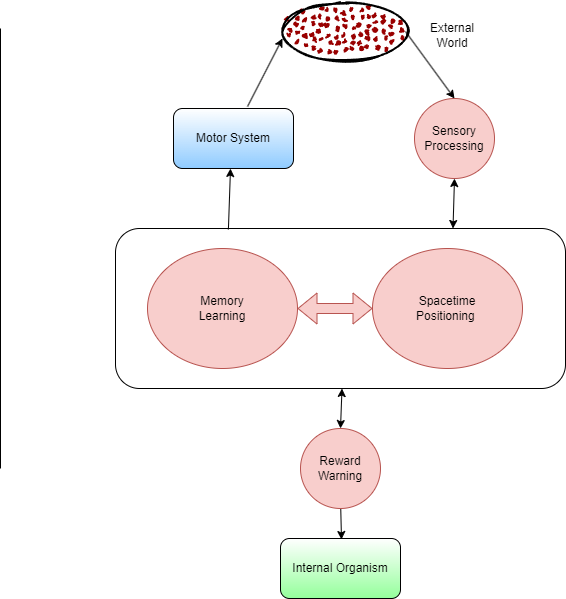
Circular processes are those participating in consciousness. Processes are not meant to reflect actual anatomy, but rather broad functional processes.
Random Speculations and Thoughts
- While the processes are not meant to reflect anatomy, the conscious processes do reflect in general terms a limbic system with sensory input. The contact point in the internal organism would be the brainstem.
- A system such as this could have evolved from a more primitive system that directly connected senses and motor systems by evolving more sophisticated processing between the two systems.
- Minimal consciousness consists of linking sensory, internal body state, and spacetime information into memory. Memory and learning at two ways of looking at the same process.
- Consciousness arose in the evolution of biological control mechanisms for systems with digestive tracts and is primarily a representation of internal states in an external world. Hence, the explanation for its subjectivity.

 Broad Speculations
Cool diagram! I like that you situated feeling in its functional role (or at least one of them). You noted that it isn’t meant to reflect anatomy, and we discussed last time how psychological categories often don’t map well to it anyway, so I take this as more at the psychological level.
One point about the limbic system. The structures historically included in it, like the hippocampus and amygdala, are above the brain stem, and really more at the level of the thalamus. It’s subcortical for sure, but more in the basal forebrain than the midbrain region.
LikeLiked by 1 person
It’s definitely intended more as functional than anatomical; however, probably the simpler the brain becomes the more likely the functional would map to the anatomical.
It was surprising to me initially to find that the amygdala had such extensive connections to the brainstem, but then again maybe not so surprising since emotions like love and fear have such extensive bodily manifestations.
“Output pathways from the central nucleus of the amygdala make extensive connections with the brain stem for emotional responses and extensive connections with cortical areas through the nucleus basalis. Cholinergic projections from the nucleus basalis to the cortex are thought to arouse the cortex”.
https://nba.uth.tmc.edu/neuroscience/m/s4/chapter06.html#:~:text=Output%20pathways%20from%20the%20central,thought%20to%20arouse%20the%20cortex.
“The limbic system is an aggregation of brain structures that are generally located lateral to the thalamus, underneath the cerebral cortex, and above the brainstem”.
https://www.ncbi.nlm.nih.gov/books/NBK538491/#:~:text=The%20limbic%20system%20is%20an,cortex%2C%20and%20above%20the%20brainstem.
I’m not sure a thalamus (or much of one) would be needed for C-Prime especially if the olfactory sense is primary. Although the thalamus may have more function than routing, it would make sense that as specialized structures developed around the core, something like a router might be needed to send sensory information directly to the specialized structures and to allow for preprocessing the information in the specialized structures before sending it to the core.
Myt view in the diagram is that reward/warning system is where mentality meets physiology. The imperative to optimize bodily systems and avoid chaotic systems creates the ability to learn
LikeLiked by 1 person
Diagram done with draw.io and I liked how it turned out. Thanks!
LikeLiked by 1 person
The interesting thing about vertebrates is that the forebrain, midbrain, hindbrain framework begins very early (initially as three swellings on the spinal cord). Fish don’t have a cortex, but they do have a pallium, a thinner sort of cortex. Which is to say, that any vertebrate version of an early conscious creature is going to have a “tween” brain, some version of a thalamus. Of course, things are much more varied with invertebrates.
Thanks for the info on draw.io! I think I tried it a while back, but probably need to look again. I’ve had a few posts that would have been vastly improved with a visual aid or two.
LikeLiked by 1 person
I would see the evolution more or less like this:
1- Basically a brainstem primarily controlling internal systems.
2- Brainstem + a rudimentary limbic system + minimal sensory capabilities.
3- Brainstem + limbic system + specialized structures in cortex for sensory processing.
4- Brainstem + limbic system + sophisticated sensory processing + reasoning capabilities
C-Prime may be 2, perhaps better categorized as having proto-consciousness. Or, C-Prime might sit somewhere between 2 and 3. 3 and 4 brains are conscious.
Some texts include the thalamus as part of the limbic system. Its elaboration and routing functions wouldn’t be needed until 3.
https://www.physio-pedia.com/Limbic_System
This is interesting and suggests an expanded limbic system with three networks.
quote
With the advancement of the understanding of the complexity of higher cognitive processes, there are suggestions that the term limbic system is no longer relevant but that it functioned as a historical framework upon which to build our current understanding of neuroscience.[32][33] Others have suggested a revised limbic system model that includes three distinct networks. The first being the hippocampal-diencephalic and parahippocampal-retrosplenial network which has a role in memory and spatial orientation. The second being the temporo-amygdala-orbitofrontal network which associates emotion with cognition. And finally, the third being the default-mode network involved in autobiographical memory and introspection.
https://www.ncbi.nlm.nih.gov/books/NBK538491/#:~:text=The%20limbic%20system%20is%20an,cortex%2C%20and%20above%20the%20brainstem.
I’m still sticking with my fragmented consciousness view for 3 and 4 type brains with an expanded limbic system as the key place of integration. The 2 brain may be conscious, not fragmented, but very rudimentary.
LikeLiked by 1 person
My quote: ” Its elaboration and routing functions wouldn’t be needed until 3″
Actually I could imagine a proto-thalamus might have been a smart router connected to the internal systems and driving the motor system from primitive sensory input. Its role would expand to routing to specialized sensory processors with the development of the core spacetime positioning and memory systems. It would still have connections to the motor systems. As it does, in fact.
“The thalamus serves as the main relay station for the brain. Motor pathways, limbic pathways, and sensory pathways besides olfaction all pass through this central structure”.
https://www.physio-pedia.com/Thalamus
LikeLiked by 1 person
I certainly like that you added a punishment/reward component since I consider that fundamental to consciousness. It took me a while to grasp how the diagram might work however. I think I now get that there’s an external world input, then a process, and ultimately a motor system that can impact the external world. I wonder if you could walk through a scenario of light entering the eye, for example, in ways that could address the various components in your diagram?
LikeLiked by 1 person
You might want to look at my more recent post which has some minor modifications.
Light enters the eye and is routed to some internal processing that results in mapping in the positioning system. The mapping itself is an internal state that is combined with reward/warning system. It might result, for example, in movement towards or away from the stimulus or nothing at all. If the stimulus is unknown but turns out to be food, for example, then learning occurs and the organism would in the future moves towards such a stimulus.
But this could also work the other way. The organism detects hunger in its internal state – that is gut is not full. It has learned a particular stimulus is food, so it actively looks for the light pattern of the stimulus.
LikeLike