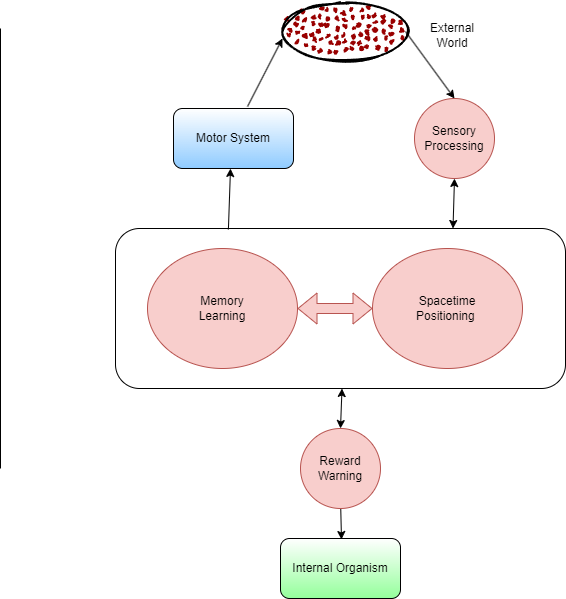
In my last post, I discussed C-Prime – the most simple, hypothetical brain and nervous system that could support consciousness. However, after that post, I realized I’d forgotten two things: feeling and a diagram. The problem in the model was there is nothing to drive learning. There would have to be a reward and warning process that reflects the states of the internal organism to attach a signature to a memory. We know this from the entire behaviorist paradigm that links learning to reward and punishment. Here’s the diagram.
Circular processes are those participating in consciousness. Processes are not meant to reflect actual anatomy, but rather broad functional processes.
Random Speculations and Thoughts
While the processes are not meant to reflect anatomy, the conscious processes do reflect in general terms a limbic system with sensory input. The contact point in the internal organism would be the brainstem.
A system such as this could have evolved from a more primitive system that directly connected senses and motor systems by evolving more sophisticated processing between the two systems.
Minimal consciousness consists of linking sensory, internal body state, and spacetime information into memory. Memory and learning at two ways of looking at the same process.
Consciousness arose in the evolution of biological control mechanisms for systems with digestive tracts and is primarily a representation of internal states in an external world. Hence, the explanation for its subjectivity.
A recent paper takes on the extradimensional explanation for consciousness: From Black Holes Entropy to Consciousness: The Dimensions of the Brain Connectome. The author, Dr. Denis LE BIHAN, seems fairly legitimate with a number of papers and significant positions held over the years. The core idea of the paper is “consciousness can naturally emerge from this four-dimensional brain connectome when a fifth dimension is considered, in the same way that gravity emerges from a ‘flat’ four-dimensional quantum world, without gravitation, present at the boundaries of a five-dimensional spacetime”. Black holes and holograms enter the discussion as well the Kazua-Klein theory that ties electromagnetism to relativity through an extra dimension. The problem with approach, as I see it, is that it would seem for the theory to work as presented in the paper, we would need to see relativistic effects in a low mass and relatively slow brain. We don’t see that, so this seems improbable.
I still think there may be something to the hologram idea which goes back at least as far the as holonomic brain theory. I will write more about this in a future post.
Another new paper claims to have discovered that when cells in the visual cortex are activated a kind of negative of the firing pattern forms in the memory areas. This suggests that the conventional view that upper level cortical uses abstract neural code might be wrong and the mapping may be more geometric. It could suggest also that memory areas may contain a reasonably complete representation of information in the sense organs.
Speaking of memory, a study has found that ripples in the brain “facilitate neuronal coupling in a phase-dependent manner and can organize the firing in entire assemblies of neurons”. “Ripples are bursts of high-frequency oscillatory activity that have recently been shown to synchronize across the cortex and may play a role in coordinating neuronal firing”. The hippocampus figures prominently in the coupling.
These findings are consistent with cortical ripples contributing to memory consolidation and recall in humans. Specifically, ripple co-occurrence could facilitate the binding of different elements of memories that are represented in disparate cortical areas, the essence of hippocampus-dependent memory.
Ripples co-occur, and remarkably, phase-synchronize across all lobes and between both hemispheres, with little decrement, even at long distances
The hippocampus is an odd structure.It has primarily been associated with memory until recent discoveries have also suggested a role on mapping location in space through place cells.
Hippocampus is a complex brain structure embedded deep into temporal lobe. It has a major role in learning and memory. It is a plastic and vulnerable structure that gets damaged by a variety of stimuli. Studies have shown that it also gets affected in a variety of neurological and psychiatric disorders.
We have two of them, one on each side, that are located at ear level and near the middle from front to back of the brain. It is shaped oddly, sometimes described as looking like a seahorse. It may be incorrect, however, to think of the hippocampus alone. Simply because anatomists have identified an area doesn’t mean that the brain uses the area in isolation from nearby areas, so interpret what I saying from here on as applying to hippocampus and associated areas. The hippocampus with its low central location would be in prime location for communication with other functional areas of the brain. What’s more, its input paths are the same as its output paths which suggests two-way communication.
There is a lot of information at the Wikipedia on the theta wave and the hippocampus.The hippocampus generates some of the strongest EEG signals in the brain. That would indicate that during wakefulness it is an area of high activity and likely stronger EM fields. During wakefulness, it has a theta rhythm of 4-8 Hertz. It shows a different pattern during sleep with irregular patterns punctuated by periods of sharp spikes. Some believe the hippocampus is where short-term memory is stored and that at night during sleep the memory is moved to longer term storage elsewhere. The hippocampus is also maybe the only place in the brain where neurons can regenerate themselves. The hippocampus is directly connected to the olfactory system
The hippocampus is found in all vertebrates. Analogous structures, which are also connected to the olfactory system, also exist in arthropods and may be used for navigation by insects. It’s location in the brain and its wide appearance across the animal kingdom suggest an ancient origin. We could speculate its direct connection to the olfactory system could suggest that smell was the first sense.
Another fascinating paper that caught my attention: Consciousness as a Memory System. This paper is long but a relatively easy read. It is jammed with basic facts and observations about how the brain works. I would recommend it just for that. I am going to quote the entire abstract:
We suggest that there is confusion between why consciousness developed and what additional functions, through continued evolution, it has co-opted. Consider episodic memory. If we believe that episodic memory evolved solely to accurately represent past events, it seems like a terrible system—prone to forgetting and false memories. However, if we believe that episodic memory developed to flexibly and creatively combine and rearrange memories of prior events in order to plan for the future, then it is quite a good system. We argue that consciousness originally developed as part of the episodic memory system—quite likely the part needed to accomplish that flexible recombining of information. We posit further that consciousness was subsequently co-opted to produce other functions that are not directly relevant to memory per se, such as problem-solving, abstract thinking, and language. We suggest that this theory is compatible with many phenomena, such as the slow speed and the after-the-fact order of consciousness, that cannot be explained well by other theories. We believe that our theory may have profound implications for understanding intentional action and consciousness in general. Moreover, we suggest that episodic memory and its associated memory systems of sensory, working, and semantic memory as a whole ought to be considered together as the conscious memory system in that they, together, give rise to the phenomenon of consciousness. Lastly, we suggest that the cerebral cortex is the part of the brain that makes consciousness possible, and that every cortical region contributes to this conscious memory system.
If this theory is correct, the hippocampus and related areas could be directly at the center of where consciousness is taking place.It could be place where much of the binding happens and it may have reasonably accurate copies of consciousness from other parts of the brain that are communicated by ripples and traveling waves.
The hippocampus is usually the place to which various neurodegenerative disorders can be traced. These disorders include Alzheimer’s and dementia. The hippocampus in people with schizophrenia. have a smaller cell volume. A number of people, however, have had portions of their hippocampus and/or amygdala removed in an effort to abate epileptic seizures. Usually only selective portions are removed based upon determination of the origin of epilepsy. Some have reported visual defects as well as the expected memory problems. One of the more extensive removals was the case of Henry Molaison or H,M as he is sometimes referred in the literature. Although the removal is sometimes described as complete, it seems unclear exactly how much was removed. A study in 2014 found that up to half of the hippocampal tissue remained. H.M. showed a variety of impairments in spatial and visual processing, but most notably the loss of ability to form new memories. He could fill in crossword puzzles when the clue was based on knowledge prior to the procedure in 1953, but could recall nothing for what happened after the procedure. Clive Wearing is another patient who suffered severe damage to the hippocampal area due to encephalitis. His condition was even worse than H.M’s. He would fill his diary with repetitive statements with timestamps minutes noting nothing more than he is now totally awake. He couldn’t remember from minute to minute.In each of these cases, however, other parts of the brain remained and could compensate for the deficits from the hippocampus. That makes a good argument that the hippocampus is only part of a larger system that generates consciousness. The authors of the Consciousness as a Memory System write: “we believe that consciousness would not be normal in individuals with complete absence or complete dysfunction of the hippocampus and related structures since birth.”
It seems apparent that consciousness in humans is located in multiple brain areas since people can lose substantial portions of it and still behave as if conscious, albeit cognitively disabled. But was this always true? Where did consciousness reside in the first conscious organism on Earth?
Let’s imagine the prototypal conscious organism in a minimalist form. We’ll call it C-prime.
It can move in the water by flippers.
It has one sense – a sense of smell.
It can detect potential food with its sense of smell.
It can react to move towards the source of food with its flippers.
How would C-prime work?
To move successfully to the food source, C-prime might have evolved a primitive hippocampus-like structure connected to the olfactory organ that can map the environment on an internal grid. It has its representative self on the grid in relationship to the food source as revealed by the strength and direction of the scent. This serves to direct its movement in the water. It starts swimming towards the food source with the information in the grid controlling the flippers.
To fine tune the search, however, another thing could be added. As it moves towards the food, small currents buffet C-prime away from the original direction slightly to the right or left, up or down. The food source could also be moving. As this happens, the scent becomes stronger or weaker. The strength of the scent in the new direction would be new information that could be used to fine tune the movement, effectively triangulating the position. However, this requires one additional feature to the hippocampus-like structure. It has to keep a record of strengths over time so it can compare the current scent with the previous scent. In other words, it needs a memory. The odd fact that the hippocampus is involved with both spatial mapping and memory makes sense.
Another interesting item that came out the Scott Aaronson thread mentioned in last post was a question to Scott about David Tong’s views on “physics laws can’t be simulated on a computer.”.
It turns out that there an unsolved puzzle that doesn’t allow the Standard Model to be simulated on a computer. I’ll let Tong explain it:
The difficulty lies with electrons, quarks and other particles of matter, called fermions. Strangely, if you rotate a fermion by 360 degrees, you do not find the same object that you started with. Instead you have to turn a fermion by 720 degrees to get back to the same object. Fermions resist being put on a lattice. In the 1980s Holger Bech Nielsen of the Niels Bohr Institute in Copenhagen and Masao Ninomiya, now at the Okayama Institute for Quantum Physics in Japan, proved a celebrated theorem that it is impossible to discretize the simplest kind of fermion.
Scott mostly dismissed the problem at first as a technical matter, but then later found the topic intriguing and one he might later post on. He still thinks its a technical; matter however, if it isn’t just technical it would mean:
“Reality is ultimately analog rather than digital. In this view, the world is a true continuum”.
Prasanna who posed the original question provided a video link. While I’m not a fan of videos, I found this one particularly interesting. The core explanation begins around 24 minutes, but there is a lot leading up to it, some of which I will need to listen to again. By the way, some of the question at the end are also really interesting.
The answer to whether we are living in a matric would be “no” if reality is analog. More correctly, it should be said we would not be living in a digital simulation.
A couple of things that caught my attention even though they are probably well-known to many.
Protons are an emergent phenomena. They emerge actually from thousands of quarks, but there happens to be small difference in the types of quarks and that number is usually what people use when they talk about the number of quarks in a proton.
Photons and gravitons are both massless. This allows them to travel at the speed of light. Odd isn’t it that the particle of gravity itself has no mass? Also, so interesting that gravity and the speed of light both have such prominent roles in Relativity. Is there some deeper connection?
The way he described reductionism made it seem to me that it might be better called “constructionism”. We can derive larger things with smaller things (although even that is practically impossible in most cases), but we can’t go the other way. We can’t look at the big things and derive the small things.A corollary is effects of the smaller things wash out as things get bigger. This is usually stated in the context of quantum fluctuations, but it might be more universally true. For example, we can derive biochemistry from chemistry but we can’t derive chemistry from biochemistry.



 Broad Speculations